
Keep old tires out of the household trash cart. Tire disposal runs through two doors: the shop that sells you new tires, which often keeps the old ones, and a county or city drop-off site or collection day. Most states bar whole tires from landfills: 39 of 50, in the U.S. Tire Manufacturers Association’s 2023 report. Fees, drop-off limits and take-back rules vary by state and county.
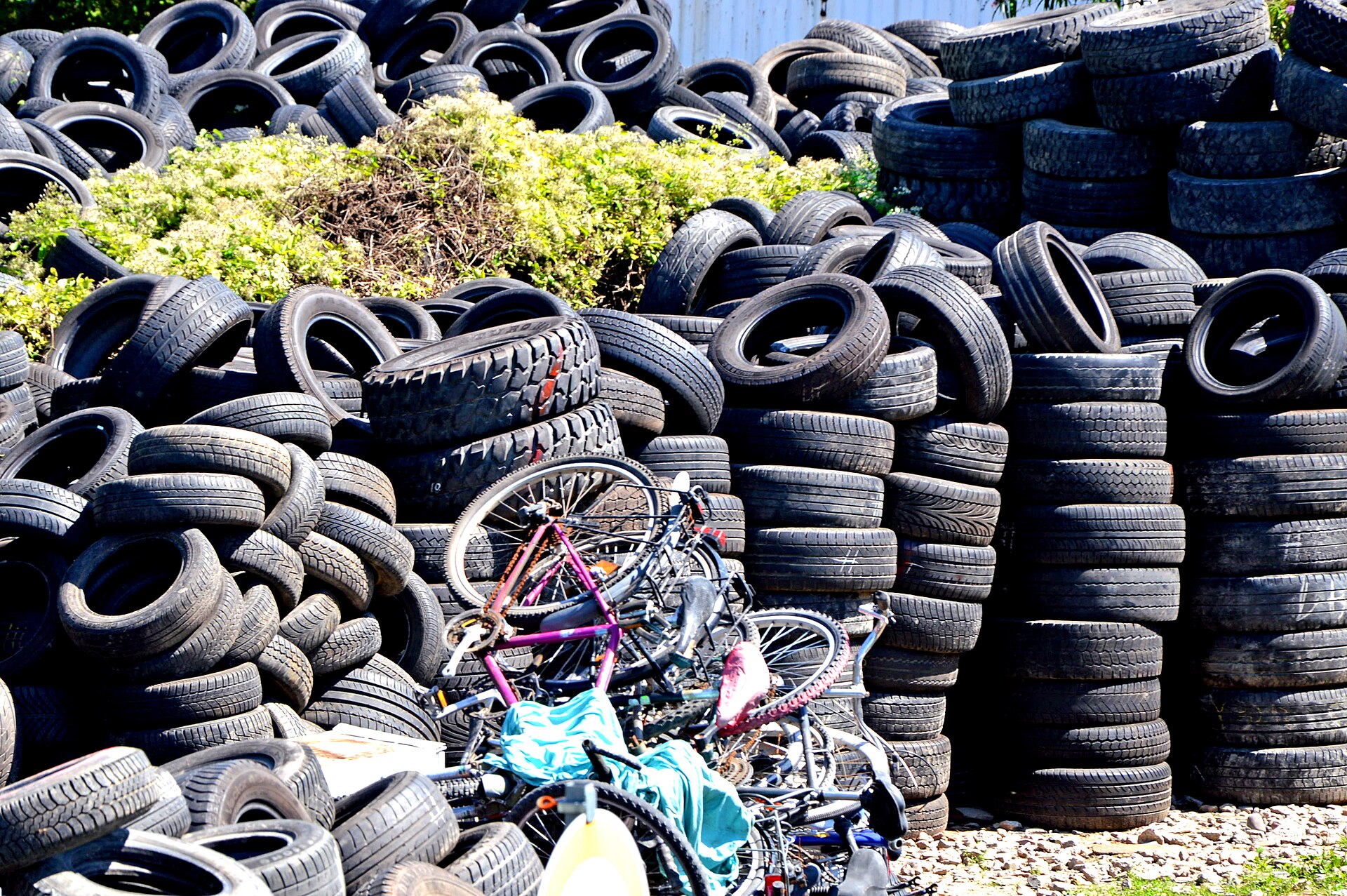
Photo: Stacks of used tires waiting to be hauled away for recycling in an industrial area of Wesseling, Germany. Spielvogel, 2016-08-07. CC0 1.0 · Source. Resized for web.
Illinois, South Carolina and Texas show how far apart the rules can be. Each state’s rules and numbers below are that state’s own.
Where old tires go
- The tire shop, when you buy new ones. Illinois law makes the seller take back as many used tires as the new tires you buy. In South Carolina, the state says the retailer keeps the old tires in most cases. Ask before you buy, because a disposal charge may apply.
- A county or city drop-off site or collection day. Every South Carolina county accepts tires from residents. In Texas, a bulky trash collection event run by your local government may take a few tires.
- A landfill, only where the state allows it. In Texas, a landfill may bury scrap tires only after they are split, quartered or shredded. Some landfills take tires from residents, usually for a fee. Call first.
- A registered hauler, for a large pile. The Texas Commission on Environmental Quality tells people with many tires that they may need to hire a scrap tire transporter.
Why tires stay out of the cart
- Landfills. Tires do not compress well and can trap methane gas. Over time they float up to the surface and disrupt the landfill, the Vermont Department of Environmental Conservation explains.
- Fire. Tire fires are extremely difficult to put out. They release toxic air pollutants and produce oil that can pollute ground and surface water, South Carolina’s Department of Environmental Services says. Illinois EPA adds that burning tires melt into an oily substance, and the runoff from firefighting water can contaminate nearby surface water.
- Mosquitoes. A tire holds rainwater. South Carolina says improperly stored tires become a breeding ground for mosquitoes that carry illnesses. Illinois EPA says the common house mosquito, the main carrier of West Nile virus, breeds in water-filled tires.
Three states, three sets of rules
Illinois
- A tire seller collects $2.50 per new or used tire sold. Since July 1, 2026, state law sends 75% of it to the Used Tire Management Fund, 21% to the Emergency Public Health Fund and 4% to the General Revenue Fund. Illinois EPA says the fee must show as a separate line on the invoice.
- The fee does not pay the shop’s disposal cost. The shop may add a separate disposal charge for each old tire it takes.
- The seller must accept, for recycling, as many used tires as the new tires you buy, and must post a sign that says “DO NOT put used tires in the trash.” If a seller refuses, Illinois EPA asks you to report it and find another retailer.
- State law bars mixing used tires, whole or cut, with municipal waste. Landfills may not take them for final disposal except in narrow cases, such as a landfill that shreds, slits or chops the tires itself.
South Carolina
- State law bars putting whole waste tires in a landfill and requires every county to run tire collection and enforcement programs.
- A $2 fee applies to each new or used tire sold with a U.S. Department of Transportation number, under the law as amended in 2025. Of each fee, $1.50, before credits, goes to the counties for tire collection, processing and recycling. The rest goes to a state waste tire grant fund.
- Tires must be recycled. All 46 counties accept tires from residents, often in limited numbers. The state gives five per day or 10 per month as examples. Call the county recycling coordinator before you load the car, or use the state’s county-by-county list.
- Counties may not add a fee for waste tires generated in the county. The exceptions cover heavy equipment and oversized tires, tires from outside South Carolina, and tires with no proof the fee was paid. Retailers may still add their own environmental fees as company policy.
Texas
- Texas sets no state tire fee. The Texas Commission on Environmental Quality says a seller may charge you for disposal or build the cost into the price of the tires.
- A permitted landfill may bury scrap tires only if they have been split, quartered or shredded. A landfill that takes tires from residents usually charges a fee, so call to confirm before you drive.
- For a few tires, check for a bulky trash collection event run by your city or county. For many tires, hire a transporter from the state’s list of registered scrap tire handlers.
What happens to them next
- Nationally, the U.S. generated about 264 million scrap tires in 2023, and 79% went to an end use, according to the U.S. Tire Manufacturers Association.
- The largest share, 33%, was burned as tire-derived fuel in cement kilns, pulp and paper mills and electric utilities. Ground rubber took 28%, for uses such as sports surfaces, playground mulch, molded products and rubberized asphalt. Civil engineering took 6%, exports 5%. Another 19% went to land disposal.
- In South Carolina, most scrap tires are chipped and burned by permitted facilities in place of other fuel. Others replace gravel in septic drain fields or become playground surfaces, landscaping mulch, truck bed mats, flooring and rubberized asphalt.
- In Illinois, most used tires become tire-derived fuel, burned with coal to make electricity or used as fuel in cement kilns.
How to find the rule where you live
- Ask the tire shop before you buy: will it keep the old tires, and what does it charge?
- Open your state environmental agency’s tire page. Each Trashbagging state hub on States & Cities names the state agency.
- Check your county or city solid waste page for a drop-off site or a collection day, and for the limit per visit. The drop-off locations catalog lists landfills, transfer stations and drop-off sites by state, with what each one takes.
- Have a large pile? Use a hauler your state registers. Vermont’s agency warns that an unpermitted hauler may dump tires illegally.
What this is not
- The state fee is not a disposal fee. Illinois’s $2.50 fee does not cover the shop’s disposal cost, and a South Carolina retailer may add its own environmental fee. Texas has no state fee at all.
- A landfill is not automatically a tire drop-off. In Texas, a landfill may bury tires only after they are split, quartered or shredded, and not every landfill takes tires.
- A household hazardous waste day is a separate program. Tires have their own drop-off sites and collection days. Check the county list before you bring tires to a household hazardous waste event.


