
EPA treats leftover household products that can catch fire, react, explode, corrode or poison as household hazardous waste. The usual list is paints, cleaners, oils, batteries and pesticides. The HHW page was last updated June 1, 2026.
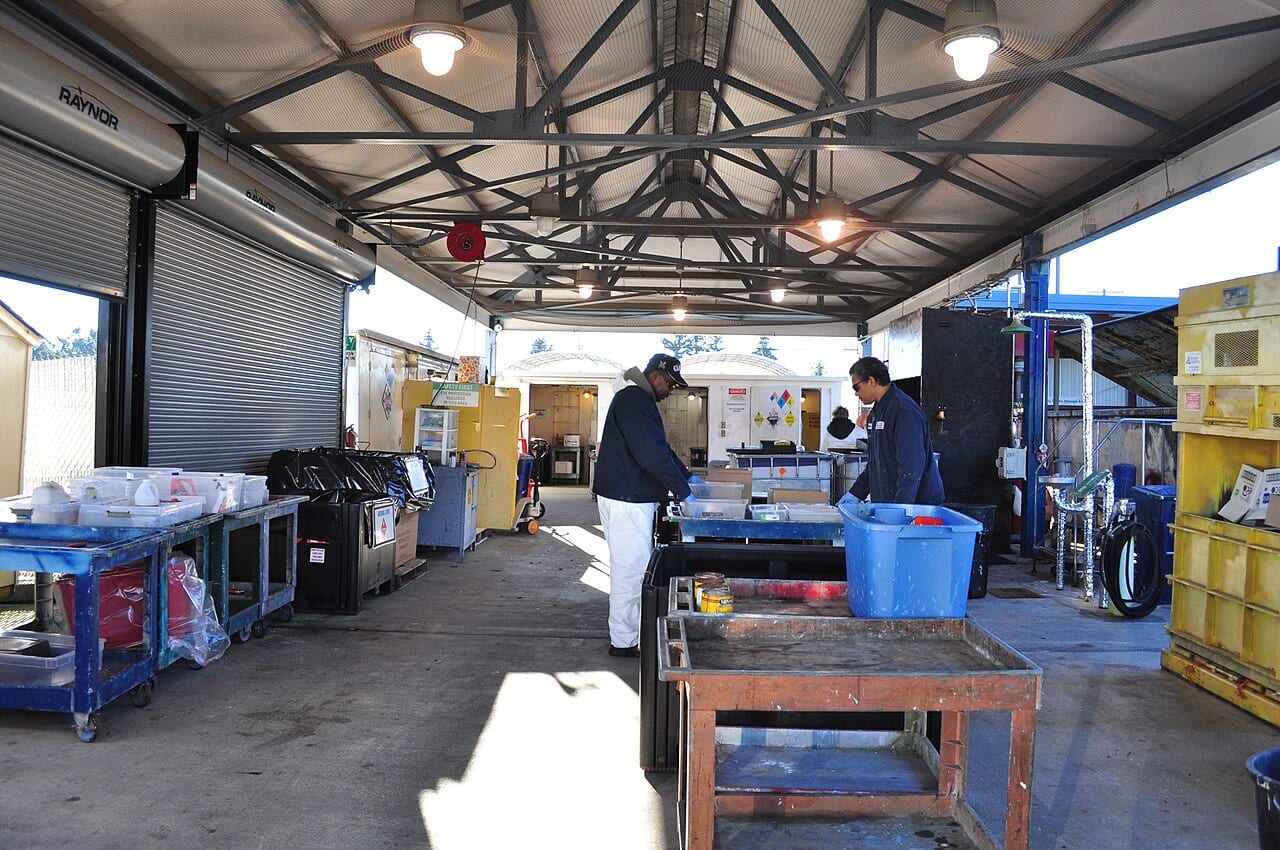
Photo: North Seattle Household Hazardous Waste Collection Facility. Joe Mabel, 2014-01-05. CC BY-SA 3.0 · Source. Resized for web.
Do not pour those leftovers down a drain, onto the ground or into a storm sewer. Some of them injure sanitation workers. Some of them wreck a septic system. An empty can can still hold residue.
Which products count
The label is the quickest test. King County’s hazardous waste program tells residents that a product whose label carries words such as caution, warning, danger, flammable, corrosive, poison or toxic is hazardous waste.
Its 2025 list of what the county’s collection sites take shows the range: household cleaners, latex and oil-based paints and stains, paint thinner and other solvents, pesticides and lawn and garden products, pool and spa chemicals, antifreeze, motor oil and other automotive products, batteries, fluorescent lights, mercury products, marine flares, and propane and butane tanks, with quantity limits on some. The same sheet turns away medicines, medical sharps, electronics, appliances, tires, smoke detectors, asbestos, explosives and empty containers. Those have their own routes, such as needles and sharps and old medication.
What to do instead
Keep products in the original labeled container. Never store them in a food jar. Do not mix leftovers — incompatible chemicals can ignite, and a mixed jug may be refused at the collection site.
Call the local environmental, health or solid-waste office and ask whether the city runs a year-round HHW site or only periodic collection days. If neither exists, some garages take used motor oil and some retailers take batteries or paint. That is a local check, not a national rule.
Is household hazardous waste disposal free?
It depends on who pays for the program. Two cities on the site show the range:
- King County, Washington, including Seattle: residents drop off at four fixed sites (North Seattle, South Seattle, Factoria and Auburn) or the traveling Wastemobile with no appointment and no fee. The county says the service is covered in utility bills. Seniors and residents with disabilities who cannot reach a site can ask for a home collection, also without a fee.
- Denver, Colorado: there is no city walk-in site. Residents of buildings with seven or fewer units book one at-your-door collection per calendar year, and each appointment carries a $15 co-payment; more than fits in the collection bag costs extra.
Where it turns local
- Austin, Texas — Austin Resource Recovery books household hazardous waste as an on-demand collection for eligible curbside customers, and the Recycle and Reuse Drop-off Center takes it by appointment.
- Phoenix, Arizona — an at-home appointment system, separate from the bulk pile.
- Nashville, Tennessee — Davidson County has a permanent site; TDEC also runs statewide mobile events.
- Middlebury, Connecticut — the transfer station does not take HHW. The region uses NVCOG events instead.
Open the locality page before you drive. States & Cities · Drop-off locations.
State starting points
- Texas Commission on Environmental Quality publishes the Texas HHW guide and county contacts.
- CalRecycle lists California local enforcement agencies.
Related: lithium-ion batteries, paint, antifreeze, used motor oil.
The federal household-hazardous-waste exemption does not make the cart a safe place for these products. State and city programs still set the drop-off.


