
Seattle garbage pickup: collection days, recycling and bulk waste rules.
The Seattle garbage pickup schedule is set by Seattle Public Utilities, with Waste Management and Recology King County trucks working under city contracts. At houses, garbage and compost go every week and recycling every other week, all on the same day. Your day comes from SPU’s address lookup or the Recycle It app. What trips people up: food scraps, greasy pizza boxes and paper towels are banned from the garbage and go in the green cart.
- Who collects: Seattle Public Utilities (SPU), through contractors Waste Management (northwest and south Seattle) and Recology King County (northeast and central Seattle), for houses, apartments and condos citywide
- Your pickup day: depends on your address; Look Up Collection Day ↗ or the Recycle It app
- Holiday changes: only Thanksgiving, Christmas Day and New Year’s Day, one day late for the rest of that week; At Your Service blog ↗
- Missed pickup: after 6 p.m. on collection day and within two business days; Report Missed Collection ↗
- Contact: (206) 684-3000; SPUCustomerService@seattle.gov
- Official website: Seattle Public Utilities: Collection & Disposal ↗
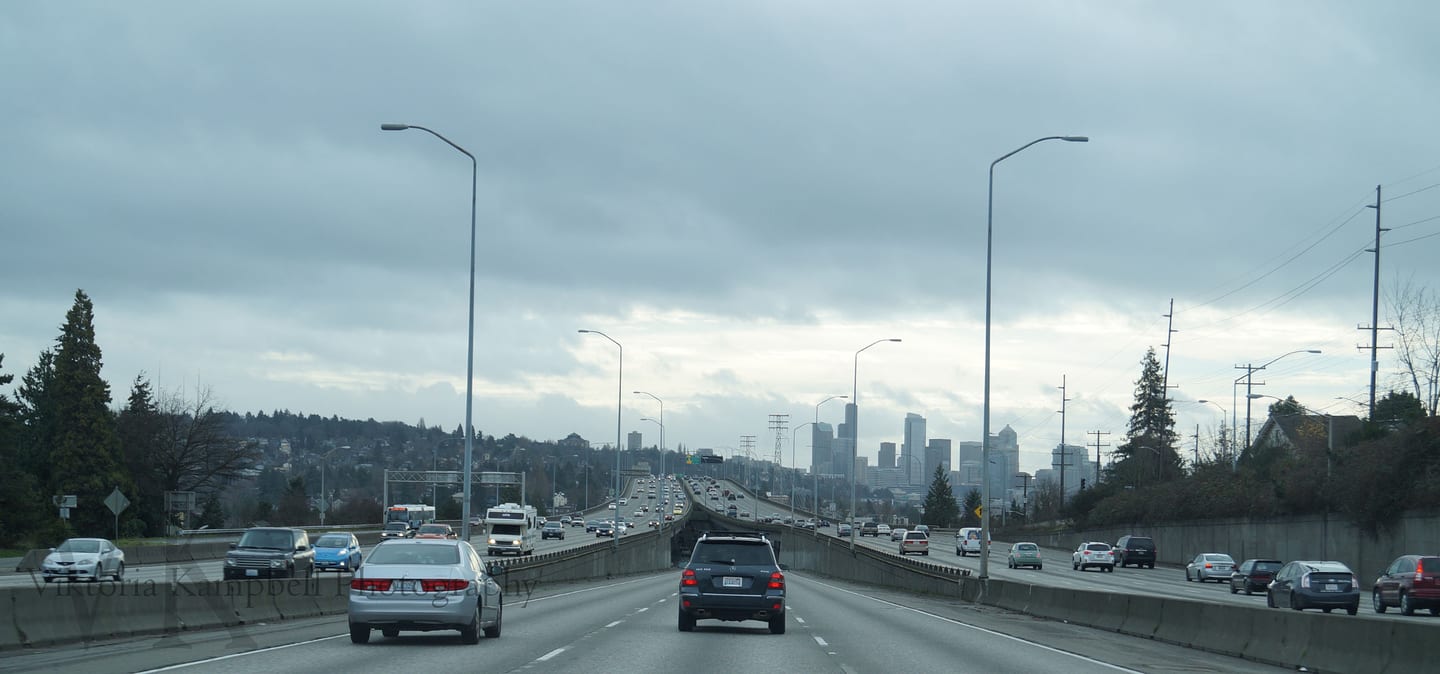
Photo: Downtown Seattle skyline viewed from the University District. Viktoria Kampbell, 2014-12-21. CC BY 3.0 · Source. Resized for web.
How the Seattle pickup schedule works
All three carts go out on one weekday set by your address. SPU sets the service and sends the bill; residents call SPU, not the hauler. Waste Management drives northwest Seattle (north of the Ship Canal, west of I-5) and south Seattle, including West Seattle. Recology King County drives northeast Seattle (north of the Ship Canal, east of I-5) and central Seattle, down to Yesler Way and I-90.
| Cart | Color and size | How often |
|---|---|---|
| Garbage | Black or gray; 12, 20, 32, 64 or 96 gallons | Weekly |
| Recycling | Blue; included in the garbage rate | Every other week, same day |
| Food and yard waste (compost) | Green; 13, 32 or 96 gallons | Weekly, same day |
| Special Item Pickup (bulky items) | No cart | By appointment, $31 a large item |
- Carts go out by 7:00 a.m., lids opening toward the street or alley, clear of sidewalks, mailboxes and other people’s driveways. Bring them in as soon as you can after collection.
- Garbage service is required at every Seattle residence, and food and yard waste service at every house of 1 to 4 units.
- Extras go beside the cart, labeled with your address: garbage at $14.40 a unit (a 32-gallon can, a large bag or a cart too full to close, 60 pounds at most), yard waste at $7.50 a unit, and recycling free, up to one 96-gallon load a day.
- In November, extra yard waste is free: up to 10 bags a collection day from November 1 to 30, for customers who pay for food and yard waste service.
- Backyard garbage pickup costs extra; call SPU to set it up.
- Apartments and condos may be collected more often. Seattle Housing Authority residents get garbage and compost service from the housing authority, not SPU.
- The online calendar does not change for weather delays; in snow and ice, SPU posts updates on its At Your Service blog.
What goes in the Seattle recycling cart
Recycling must be empty, clean, dry and loose, never bagged. Check any item in SPU’s Where Does It Go? tool ↗ or email AskEvelyn@seattle.gov.
- Yes:
- newspaper, magazines and office paper
- cereal and other food boxes
- flattened cardboard, tape is fine
- plastic bottles, jugs, containers and tubs
- aluminum and steel cans
- clean foil trays
- scrap metal
- glass bottles and jars
- rinsed milk cartons
- No:
- plastic bags and wrap, even bundled
- bagged recyclables
- drinking glasses and window glass
- foam
- bubble mailers
- candy wrappers
- food and liquids
- shredded paper
- greasy pizza boxes
- paper towels and napkins
- batteries
- electronics
Items must be bigger than 3 inches, and loose lids at least 3 inches wide; smaller pieces fall through the sorting equipment and go in the garbage. Shredded paper, greasy pizza boxes, paper towels and napkins go in the compost cart instead. Cardboard beside the cart must be broken down smaller than 4 by 4 feet.
Yard waste and food scraps
The green cart goes weekly. Food and compostable paper have been banned from Seattle garbage since 2015, and yard waste is not allowed in the garbage either.
- Yes:
- all food, including meat, bones, shells, fish and dairy
- moldy leftovers
- food-soiled paper, paper towels and napkins
- shredded paper
- packaging and bags labeled “Compostable”
- leaves and grass
- branches and plants
- clean unpainted wood
- No:
- plastic, metal or glass
- coated or shiny paper plates
- milk cartons
- plastic bags
- liquids
Line the kitchen pail with uncoated paper or an approved compostable bag. Extra yard waste goes beside the cart in a labeled 32-gallon can, kraft paper bags, approved compostable bags or bundles tied with fiber twine up to 4 feet long and 2 feet across; food waste is allowed only inside the city cart. Christmas trees were composted free from December 26 to January 31 last season: two per house beside the compost cart, cut to 4-foot lengths with decorations and flocking removed, or three per vehicle at a transfer station.
Bulk trash pickup in Seattle: Special Item Pickup
Bulky and awkward items go through SPU’s Special Item Pickup, recycled wherever they can be. The utility account holder books it online or at (206) 684-3000; in apartment buildings the owner or manager books it. Charges go on the utility bill.
| Item | Price | Limits |
|---|---|---|
| Furniture, mattresses and box springs, appliances, TVs, computers and other items over 2 by 2 by 2 feet | $31 each | 300 pounds, 8 feet tall, 4 feet across; cover in rain |
| Refrigerators and freezers with CFCs, such as pre-2005 models | $39.25 each | Remove latching doors or tie them shut |
| Household batteries | One free pickup a year, then $5 | Two 1-gallon bags, ends taped |
| Special Items Box | One free a year, then $20 | One 2 by 2 by 2-foot box under 60 pounds: up to 4 small propane canisters, a bag of batteries, a bag of bulbs, small electronics |
| CFL bulbs | $5 a pickup | Two 1-gallon bags, no broken bulbs |
| Small propane canisters | $5 a pickup | Up to 4 empty canisters under 1 pound |
| Foam blocks | Free | Two 32-gallon bags |
| Used cooking oil or motor oil | Free, no booking | Two sealed 1-gallon jugs, labeled with your address, set out on your collection day |
- Accepted:
- sofas, chairs, tables and dressers
- mattresses and box springs
- washers, dryers, stoves and dishwashers
- refrigerators and freezers
- TVs, monitors and computers
- removable rechargeable batteries, such as power tool batteries
- Refused:
- car batteries
- e-bike and e-scooter batteries
- packing peanuts
- broken bulbs
- mixed oil
Transfer stations also take furniture and mattresses as garbage by weight, and appliances at $34 each, two a load.
Seattle garbage pickup holidays
Seattle collects garbage, recycling and compost on every holiday except Thanksgiving, Christmas Day and New Year’s Day. On those three days there is no collection: the holiday’s route and every later route that week run one day late, and Monday to Wednesday routes do not change. Both transfer stations and both hazardous waste facilities close on those three days.
| Holiday | Date | Collection change |
|---|---|---|
| Indigenous Peoples’ Day | Monday, October 12, 2026 | None; collection as usual |
| Veterans Day | Wednesday, November 11, 2026 | None; collection as usual |
| Thanksgiving Day | Thursday, November 26, 2026 | Closed; Thursday and Friday collections each one day late, on Friday and Saturday |
| Christmas Day | Friday, December 25, 2026 | Closed; Friday collection one day late, on Saturday, December 26 |
| New Year’s Day | Friday, January 1, 2027 | Closed; Friday collection one day late, on Saturday, January 2 |
Hazardous waste, electronics and drop-off sites
Household hazardous waste goes free, with no appointment, to two Seattle facilities open to all King County residents. They take pesticides, cleaners, oil-based paint, solvents, antifreeze, motor oil, pool chemicals, fluorescent lights, propane tanks, batteries and anything labeled caution, warning, danger or poison, in containers of 5 gallons or less. Old gasoline and other fuels are limited to 25 gallons a trip, in approved safety cans. They refuse latex paint, medicines, sharps, electronics and tires.
- North Household Hazardous Waste Facility, 12550 Stone Avenue North, Seattle, WA 98133. Sunday to Tuesday, 9 a.m. to 5 p.m. Closed July 4, Thanksgiving, Christmas and New Year’s Day.
- South Household Hazardous Waste Facility, 8100 2nd Avenue South, Seattle, WA 98108, by the South Transfer Station. Thursday to Saturday, 9 a.m. to 5 p.m. Same closures.
- North Transfer Station, 1350 N 34th Street, Seattle, WA 98103. Its Recycling and Reuse Building takes free bicycles, cardboard, scrap metal, used motor oil, household sharps, all batteries and clean recycling.
- South Transfer Station, 130 S Kenyon Street, Seattle, WA 98108.
Both transfer stations are open daily 8 a.m. to 5:30 p.m. (10 a.m. on the first Wednesday of the month) and close on Thanksgiving, Christmas and New Year’s Day, North also on July 4. Rates from April 1, 2026: recyclables free; garbage $37 for up to 420 pounds, then $174 a ton; clean yard or wood waste $25, then $132 a ton; tires $16 for up to four; household sharps free, up to one gallon. They take no hazardous waste, electronics, fuel tanks or asbestos. Information: (206) 684-8400.
Since 2024, batteries and electronics are banned from Seattle garbage and recycling. Batteries go free to the hazardous waste facilities or Call2Recycle sites; TVs, computers and monitors go free to E-Cycle Washington sites. King County residents 65 or older, or with a disability, can book a free home pickup of hazardous waste at 206-296-4692.
Fees and billing
Garbage service is required at every residence and billed every other month on the combined utility bill. Recycling is included, and a smaller garbage cart costs less.
| Cart | Monthly rate from April 1, 2026 |
|---|---|
| Garbage, 12 gallons | $29.20 |
| Garbage, 20 gallons | $35.80 |
| Garbage, 32 gallons | $46.55 |
| Garbage, 64 gallons | $92.90 |
| Garbage, 96 gallons | $139.50 |
| Food and yard waste, 13 / 32 / 96 gallons | $7.75 / $11.60 / $14.75 |
Backyard garbage pickup runs $65.00 a month for a 32-gallon cart. A second garbage-cart size change in one calendar year can cost $35.75. A house empty for 60 days or more can get a $6.85 monthly vacancy rate. The Utility Discount Program takes 50% off SPU bills for households at or below 70% of state median income; call (206) 684-0268.
Missed pickup, damaged carts and new carts
- Check the week: after Thanksgiving, Christmas Day or New Year’s Day, the rest of that week runs one day late.
- Look for an “Oops” tag on the cart. If the driver left one, fix the problem for your next collection day instead of reporting a miss.
- Wait until after 6:00 p.m., then report it within two business days online, in the Recycle It app or at (206) 684-3000. SPU reschedules the pickup within 24 hours.
Missing or damaged carts and size changes go through the same channels. If a miss turns out to be the customer’s error, a fee may apply to future special collections.
Set-out rules and fines
- City code bans food, compostable paper, yard waste and recyclables from the garbage.
- Drivers leave “Oops” tags for problems such as garbage in recycling or plastic in compost; a cart too full to close is billed as extra garbage.
- Apartment buildings can be charged $50 after two warnings for recyclables in the garbage.
- A special pickup of one container outside your regular collection costs $57.05.
Materials with their own rules
-
Needles and sharps: containers, designated drop boxes and mail-back.
-
Used motor oil and filters: separate oil collection and local filter preparation.
-
Acetone and bleach: keep leftovers separate and use the household hazardous-waste program.
-
Pizza boxes: greasy ones go in the green compost cart.
-
Styrofoam: foam trays and containers go in the garbage; Special Item Pickup takes two 32-gallon bags of foam blocks free.
-
Mattresses: $31 by Special Item Pickup.
-
Lithium-ion batteries: banned from the garbage; e-bike and e-scooter batteries are not picked up at home.
-
Household batteries: every battery, alkaline included, is banned from the garbage; tape the ends and take them to the North or South hazardous waste facility, free.
-
Old gasoline: free at the two hazardous waste facilities, up to 25 gallons a trip.
-
Antifreeze: free at the North and South hazardous waste facilities, never down a drain.
-
Household hazardous waste: free at the North and South facilities.
-
Paint: oil-based paint to a hazardous waste facility; SPU points to free PaintCare sites.
-
Cooking oil and grease: two sealed jugs beside the carts, free.
-
Christmas trees: free composting after Christmas.
-
Tires: $16 for up to four at a transfer station.
-
Aerosol cans and propane tanks: propane tanks to a hazardous waste facility; small empty canisters by Special Item Pickup.
-
Light bulbs: incandescent and LED bulbs go in the garbage; fluorescent bulbs and tubes go to the North or South household hazardous waste facility, free.