
How to dispose of old gasoline: keep it sealed in a gas can made for fuel and take it to your city or county household hazardous waste collection. Never put it in the trash or recycling cart. Never pour it down a drain, into a storm drain or on the ground. New York’s environmental agency calls gasoline highly flammable and extremely toxic.
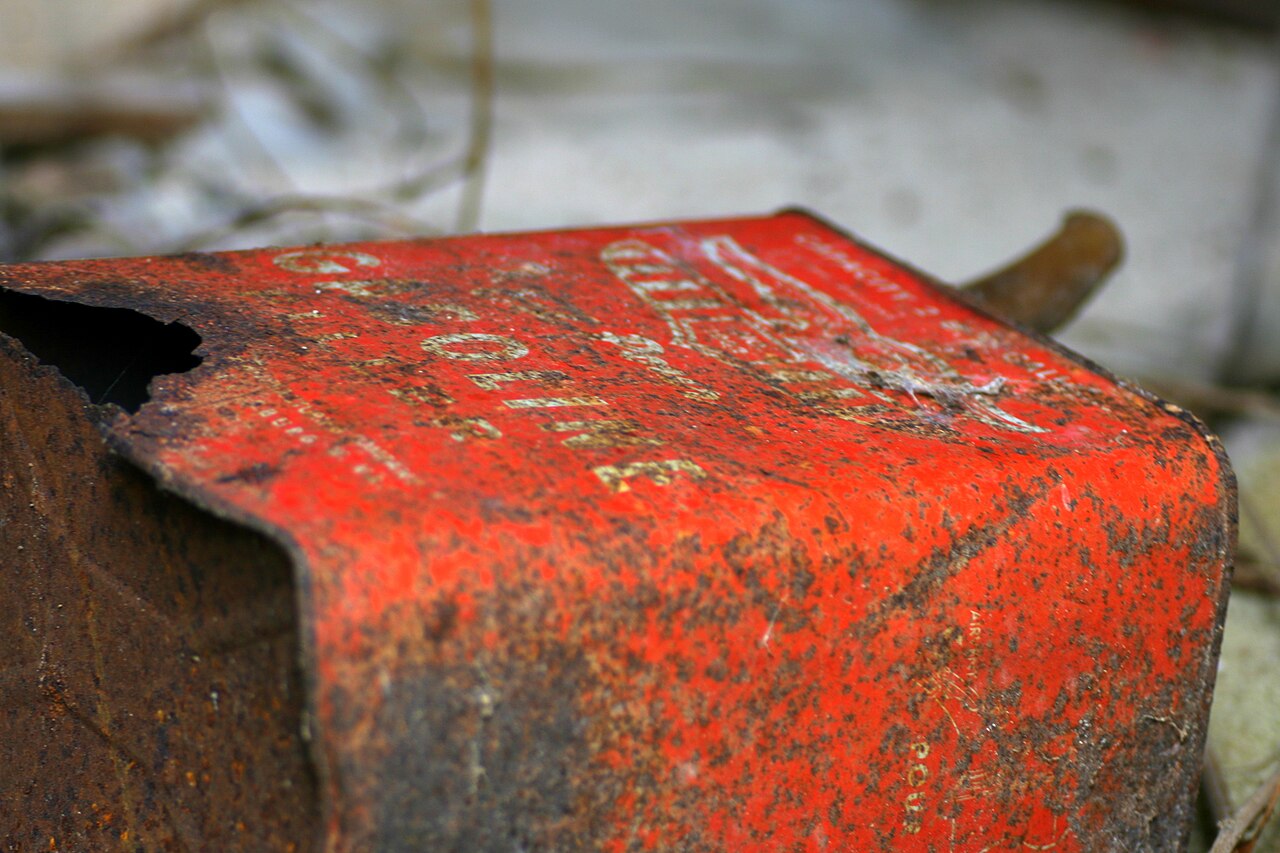
Photo: A rusted, dented old red metal gas can. John Trainor, 2008-02-03. CC BY 2.0 · Source. Resized for web.
Seattle, Denver and Houston all collect old gasoline from residents, each under its own limits, listed further down.
Why old gas is household hazardous waste
- It catches fire. EPA counts leftover household products that can catch fire, react or explode, or that are corrosive or toxic, as household hazardous waste. Maine’s Department of Environmental Protection (DEP) calls gasoline flammable and toxic.
- The cart, the drain and the ground are off limits. The New York State Department of Environmental Conservation (DEC) says never to put gasoline in household garbage or recycling, or pour it into storm drains, septic systems or on the ground.
- The drop-off is local. EPA says household hazardous waste is regulated at the state and local level, so your city or county runs the collection.
How to store old gas until the drop-off
- Use a real gas can. Maine DEP says to keep gasoline in UL-approved containers, red for gasoline, clearly labeled, and never in a glass jar or a plastic milk jug.
- Keep it separate. EPA says never to mix household hazardous waste with other products, because incompatible products can react, ignite or explode. New York’s DEC says not to combine gasoline with any other automotive product.
- Keep it out of the house. Maine DEP suggests a well-ventilated shed or detached garage, out of children’s reach and away from a drinking water well.
Can old gasoline be used up?
Two state agencies say some of it can. Maine DEP says “unmixed ‘old’ gas can be burned in your car by diluting one part old fuel with five parts new fuel.” New York’s DEC gives the same one-to-five mix for old gasoline with no liquid contamination and says to check your owner’s manual first.
Some old gas cannot be saved. New York’s DEC says gasoline mixed with fluids such as brake fluid or antifreeze cannot be reused and is hazardous waste. Maine DEP sends gas that has turned gummy, picked up dirt and water, or separated to a household hazardous waste drop-off.
To keep the next can fresh, Maine DEP says to buy only what you need and to add a stabilizer to gasoline you will keep more than 30 days.
Where it turns local
Seattle and King County: free drop-off, 25 gallons a trip
- The King County Hazardous Waste Management Program takes gasoline, diesel, kerosene and other fuels at its sites, which serve Seattle and the rest of King County, Washington.
- Each container must hold 5 gallons or less, and the limit is 25 gallons per trip. Bring the fuel in an approved safety can labeled “gasoline.” You can ask to get the can back.
- North Seattle, 12550 Stone Avenue North, is open Sunday to Tuesday. South Seattle, 8100 2nd Avenue South, is open Thursday to Saturday. Both run 9 a.m. to 5 p.m. The county’s flyer says no appointment and no fee.
- King County transfer stations take no petroleum products such as motor oil, even in household quantities.
Denver: At-Your-Door pickup for a $15 co-pay
- In Denver, Colorado, the city’s Household Hazardous Waste Collection Program lists gasoline among the items it picks up at your home.
- Denver residents get one appointment per calendar year, with a $15 co-payment.
- You need at least three different types of accepted materials, or one material over 25 pounds, to qualify.
- Schedule at 1-800-449-7587 or wmatyourdoor.com, and set the bag out by 7 a.m. on your appointment day.
Houston: 15 gallons at an Environmental Service Center
- In Houston, Texas, the Solid Waste Management Department takes up to 15 gallons of fuel at its two Environmental Service Centers.
- The centers do not pour gas. Your gas cans stay at the center, unless you pour the fuel into clean buckets with lids before you arrive.
- ESC South, 11500 S. Post Oak Rd., is open Tuesday, Wednesday, Friday and Saturday, 8 a.m. to 5 p.m. ESC North, 5614 Neches St., opens the second Thursday of each month, 9 a.m. to 3 p.m.
How to find your local answer
- Open your city or county page from States & Cities. Its hazardous waste section names the drop-off site or pickup program.
- Search the drop-off locations catalog for a household hazardous waste site, and read what it takes.
- Ask your county’s household hazardous waste program. EPA says to contact the local environmental, health or solid waste agency about permanent sites or collection days.
- Before you load the car, check the program’s container size, gallons per trip and whether it needs an appointment.
What this is not
- Used motor oil. Oil has its own collection. King County says many repair shops, auto supply stores and gas stations that sell oil take it back. Maine DEP warns never to mix leftover two-cycle gas and oil with used crankcase oil, because the mixture could explode in a waste oil burner.
- The empty gas can. King County lets an empty gas can go in the garbage after it vents for two or three days with the lid open.
- Propane tanks. A grill tank or camping cylinder has its own rules; see aerosol cans and propane tanks.
- Lawn equipment. Houston’s centers take a mower or other lawn equipment only with all fluids completely removed.


