
Aerosol cans and propane tanks do not go in the trash or recycling cart while they still hold product or gas. Both can explode in a collection truck. Disposal of an empty can depends on the place: New York City and Austin take empty aerosol cans in recycling. Full cans go to hazardous waste collection in New York City and Montgomery County, Pennsylvania. A grill tank goes back to an exchange, a propane supplier or a hazardous waste drop-off.
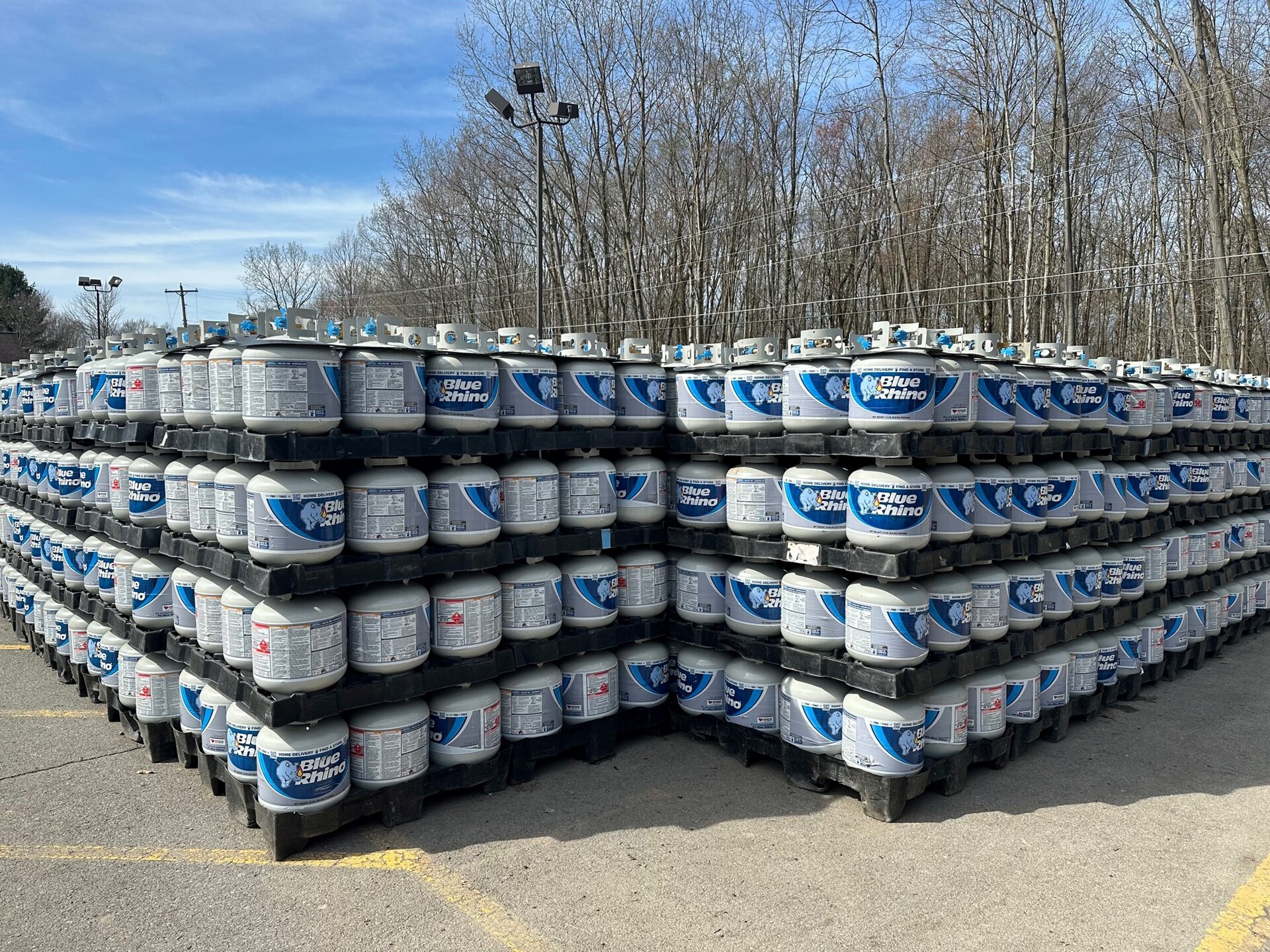
Photo: Stacks of Blue Rhino propane tanks on pallets in Grove City, Pennsylvania. ErinShea112233, 2023-04-19. CC BY-SA 4.0 · Source. Resized for web.
Is the aerosol can empty?
Montgomery County, Pennsylvania, gives a simple test. A can is empty when you no longer hear air come out as you press the nozzle and it feels empty when you shake it. The county warns that a full or partly full can may explode in a compactor truck.
Ohio EPA says never to recycle or throw out an aerosol can unless it is empty. If the product is non-toxic, Ohio EPA and Montgomery County describe how to empty the can: spray what is left into a box outdoors and let it dry. Montgomery County suggests a deep cardboard box or a paper bag. Ohio EPA says to do it away from ignition sources, children and pets, to protect your eyes and skin, and to avoid breathing the vapor. Never put the wet box in a closed garbage can, where vapor can build up.
That method is for non-toxic products only. Onondaga County’s recovery agency, OCRRA, sends any can that still holds paint or household toxics to its hazardous waste drop-off. None of the official pages cited here tells a household to puncture an aerosol can.
Where an aerosol can goes
Each program publishes its own rule:
- New York City: the Department of Sanitation takes empty aerosol cans in metal, glass and plastic recycling. Full aerosol cans go to a SAFE Disposal Event, NYC311 says. The department’s Special Waste Drop-Off page also lists aerosols, while NYC311’s chart says those sites do not take full cans, so check before you drive.
- Austin, Texas: Austin Resource Recovery takes empty aerosol cans in the blue recycling cart. Full or partly full cans stay out of it, and the city points residents to its What Do I Do With tool for disposal.
- Montgomery County, Pennsylvania: empty cans go in curbside recycling. Full or partly full cans go to a household hazardous waste event.
- Onondaga County, New York: OCRRA takes an empty can in recycling only if it never held household toxics. An empty can that held paint or toxics goes in the trash. A can with paint or toxics still inside goes to the hazardous waste drop-off, by appointment.
- Ohio: Ohio EPA says many household recycling programs accept empty aerosol cans, and an empty can may go in the regular trash or recycling. Household hazardous waste disposal is most often run by the county or local solid waste management district.
Propane grill tanks
Do not put a 20-pound grill tank in the trash, a dumpster or the recycling bin. New York City’s sanitation department says gas cylinders can explode inside its collection trucks. The LP-gas section of North Carolina’s agriculture department says a compacting truck can crush and rupture a cylinder. Ramsey/Washington Recycling & Energy in Minnesota says a tank that looks empty can still hold gas.
If the tank still works, refill it or exchange it. For a tank you no longer want, the Propane Education & Research Council (PERC) lists a local propane supplier, the household hazardous waste site and the public works department. Blue Rhino’s own instructions for recycling a grill tank: write “R” or “RECYCLE” on it, take it to a Blue Rhino location with an open spot in the display and tell a store employee. Blue Rhino says it refurbishes the tank if it can and recycles it if it cannot.
Some public programs take tanks directly. Ramsey and Washington county residents can drop off propane tanks up to 100 pounds free at the county environmental centers. New York City takes propane tanks at SAFE Disposal Events. Connecticut’s environmental agency, DEEP, points residents to a municipal transfer station where one exists, or to a household hazardous waste collection that accepts tanks.
A scrap yard is not a sure thing. New York City lists a scrap metal dealer as one option. Albuquerque’s solid waste department says most scrap yards will not take an intact propane tank, even an empty one. Ohio EPA says a propane container can go to scrap or disposal only after a professional removes the valve and a hole shows that it is empty.
Do not do that work yourself. PERC says not to remove the valve, cut or puncture a tank, and Connecticut DEEP also warns against removing the valve.
Why an old tank gets turned away
Connecticut DEEP says a grill tank is stamped with its manufacture date, which starts a 12-year life span. North Carolina’s LP-gas section cites the propane code, NFPA 58: new cylinders holding 4 to 40 pounds have needed an overfill prevention device since 1998, and a cylinder without one may not be filled after March 31, 2002. North Carolina suggests exchanging an old cylinder for one with the new equipment. Some exchange companies charge a one-time upgrade fee.
One-pound camping cylinders
The small cylinders that fuel camp stoves, lanterns and heaters get different answers in different places:
- North Carolina: the LP-gas section says a one-pound cylinder may go in the regular trash, but not in a recycling bin.
- California: the Department of Toxic Substances Control tells households to take used gas cylinders to household hazardous waste facilities. CalRecycle warns that cylinders can hold flammable gas even when they seem empty, and says SB 1280 prohibits the sale of propane cylinders other than reusable or refillable ones by January 1, 2028.
- New York City: the Department of Sanitation keeps all compressed gas fuel canisters, propane and butane included, out of trash and recycling.
- Albuquerque: the city sends single-use and small refillable cylinders to a propane marketer, a pressurized gas retailer or a gas service company.
Connecticut DEEP notes that refillable one-pound cylinders are now sold nationwide.
Finding the drop-off
Household hazardous waste collection is a local program. EPA tells households to ask the local environmental, health or solid waste agency about a permanent site or a collection day. In Ohio, the solid waste management district is the contact. Start with drop-off locations and your state on States & Cities, then confirm the rule on your city’s own page.
What this is not
The federal universal waste rule. EPA added aerosol cans to its universal waste rules in 2019 (84 FR 67202), next to batteries, pesticides, mercury-containing equipment and lamps. The change eases hazardous waste handling for retail stores and other establishments that discard aerosol cans. It is not a rule for your cart. Federal rules exclude waste from normal household activities from the definition of hazardous waste, and states and local governments regulate it. A can that meets the federal definition of empty is not universal waste at all.
A bulk propane tank. A large tank at a house is a job for a licensed propane company, which can purge the gas and remove the tank, PERC says.


