
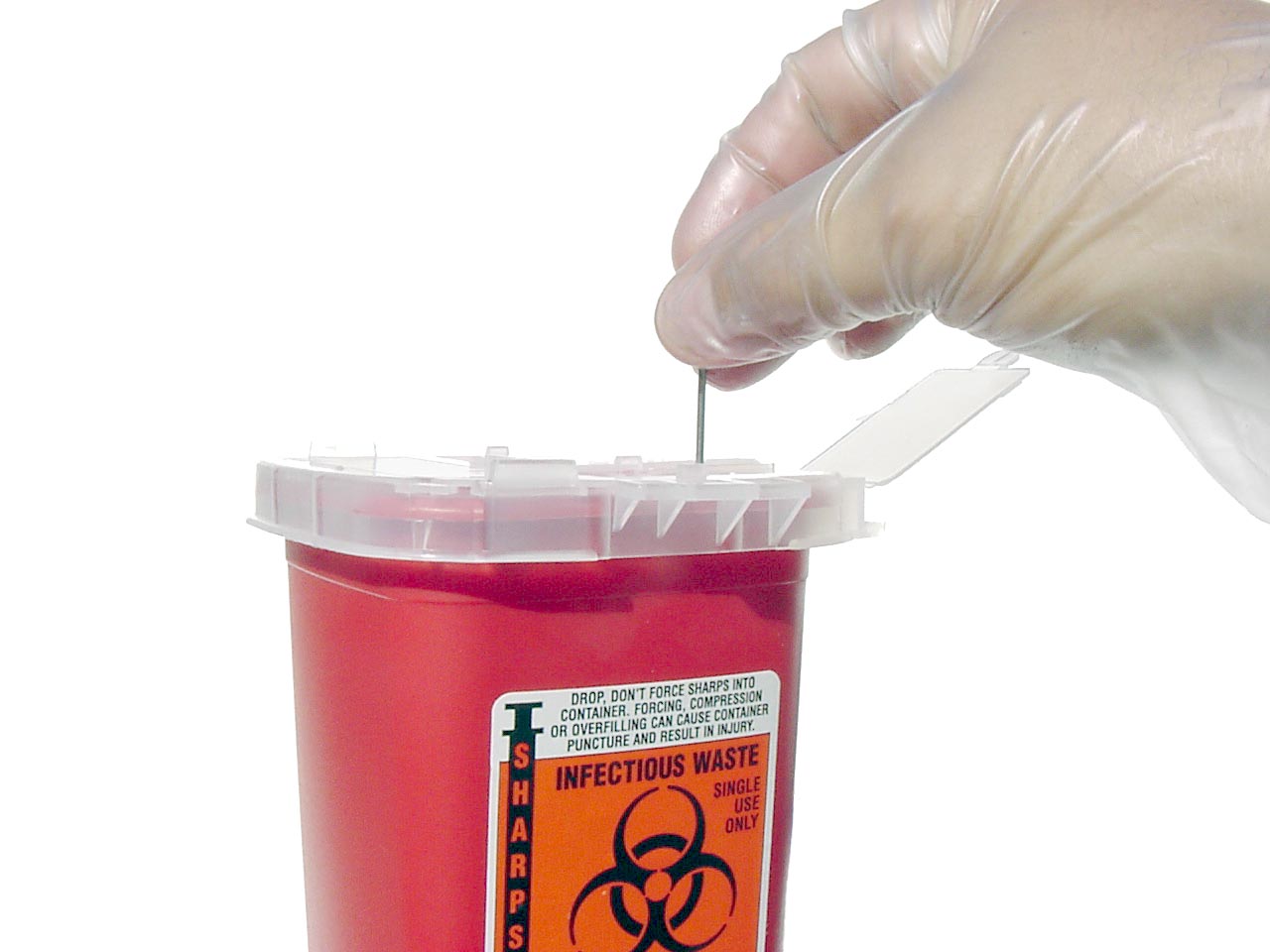
How to dispose of needles and sharps starts with a container, not a trash bag. Put each used needle straight into a sharps container, close it before it becomes overfilled, and use the disposal route your city or county accepts. Loose sharps never belong in trash, recycling or the toilet; a sealed container still needs a local answer.
Photo: A gloved hand placing a sharp in a red container. William Rafti, William Rafti Institute, June 29, 2003 (EXIF). CC BY 2.5 · Source.
A lancet from a blood-glucose test, a needle used for a pet’s medicine and a used injection needle all need this care. The FDA’s advice covers consumers at home, at work and while traveling. It does not turn a household drop box into a disposal service for a medical business.
What is true everywhere
The FDA recommends putting used sharps in an FDA-cleared disposal container immediately after use. These containers have rigid sides and a lid designed to resist punctures. Keep the container out of reach of children and pets. The point is to contain the sharp before anyone has to handle a bag or sort recycling.
If an FDA-cleared container is unavailable, the agency describes a heavy-duty household plastic container as an alternative, such as a laundry-detergent container. It should resist leaks, stand securely upright, close with a tight, puncture-resistant lid and carry a warning about the sharps inside. That does not mean every local program accepts every household container; check its requirements before choosing one.
Injection pens count as sharps too. The FDA’s list of sharps includes auto-injectors, naming epinephrine and insulin pens. The pen’s own instructions say which part goes in the container. Lilly tells users of the Zepbound single-dose pen to put the whole used pen in an FDA-cleared sharps container right away and never in household trash. For the multi-dose Zepbound KwikPen, the screw-on pen needle goes into the container after each dose; the used-up pen, with its needle removed, may go in household trash or the sharps container.
The FDA says to start the disposal step when the container is about three-quarters full, because overfilling raises the risk of a needle stick, and not to reuse a sharps container. Keep the lid secure so sharps cannot escape. King County’s drop boxes do not return containers for reuse.
The FDA warns against loose sharps in household or public trash, recycling bins and toilets. Disposal of a closed container is a separate question: local programs differ. A container keeps the points enclosed; it does not make the contents recyclable.
Where it turns local
Seattle: designated boxes, not the garbage cart
In Seattle, Washington, King County Public Health says sharps cannot go in regular garbage or recycling. Its list includes the North Transfer Station, 1350 N 34th Street, and South Transfer Station, 130 South Kenyon Street.
Seattle’s sharps brochure distinguishes large drop boxes that take containers up to two liters from small boxes intended for single sharps. The large boxes are available around the clock. Use the correct box for the container you have; a small opening is not permission to leave a full container beside it.
Public Health also lists a 24-hour outdoor box at the Downtown Public Health Center, 2124 4th Avenue. It accepts securely sealed, bottled sharps. If a container will not fit, the county directs people to the reception desk during its stated weekday hours, Monday through Friday, 8 a.m. to 5 p.m. Never leave sharps outside the box.
King County outside Seattle: free container drop-off
For residents of King County outside Seattle city limits, Public Health lists free drop boxes at Bow Lake, Factoria, Shoreline and Vashon recycling and transfer stations. Sharps must be safely enclosed in a container.
One listed option is Factoria Recycling & Transfer Station, 13800 SE 32nd Street in Bellevue. Follow the sharps-box instructions there. A transfer station can host several collection services with different acceptance rules; its general garbage or hazardous-waste service is not the sharps drop box.
Check the county’s current location list before traveling. A doctor’s office or pharmacy may also accept containers, but Public Health says to ask about availability, packaging and fees. It does not promise take-back at every pharmacy.
San Francisco: no loose needles and a free mail-back option
San Francisco, California, directs household needles to its sharps program rather than a disposal bin. SF Environment says no loose needles and no business waste. Its location list asks residents to call ahead about opening hours and availability.
The department also offers a prepaid mail-back package at no cost. A request can be made through the official sharps page. The package includes a collection container and a prepaid return label for the full container. Use the supplied package and instructions; a normal parcel addressed to a pharmacy is not a sharps mail-back program.
How to find your local answer
- Start with your city or county page, then open the health department’s sharps instructions.
- Confirm whether the service takes household sharps, which containers it accepts, the maximum size and any charge.
- For a drop-off, check the actual sharps-box address and access hours. A drop-off location that accepts paint or oil may refuse needles.
- For mail-back, get the program’s container, packaging and return label before filling it.
- Keep the container closed while transporting it and put it in the designated collection point.
FDA guidance lists possible routes, including supervised collection, hazardous-waste sites, mail-back and special pickup. These are possibilities to check locally, not a list of services every town must offer.
What this is not
Not ordinary broken glass. A glass fragment follows its own packaging rules; a used injection needle needs the sharps route.
Not a medicine take-back bag. A program for leftover tablets does not automatically accept needles, syringes or injection devices.
Not general hazardous-waste acceptance. King County’s household hazardous-waste brochure lists medical sharps among items it does not accept. Use the county’s separate sharps-box list instead.
Not a business medical-waste service. Household eligibility matters. San Francisco expressly excludes business waste, and the FDA separates consumer advice from guidance for health care facilities.


