
- Who collects: Recology San Francisco, including Recology Sunset Scavenger and Recology Golden Gate
- Your pickup day: depends on your address; Collection Calendar ↗ or 415-330-1300
- Holiday changes: regular service except Christmas Day and New Year’s Day; Holiday Calendar ↗
- Missed pickup: email customerservice@recologysf.com, identifying each missed bin
- Contact: Sunset Scavenger 415-330-1300; Golden Gate 415-626-4000
- Official website: Recology San Francisco ↗
The San Francisco trash pickup schedule depends on your service address. Recology collects landfill, recycling and compost at least weekly; use its address calendar or call customer service to confirm your day. Set bins out the night before, no earlier than 6 p.m., and retrieve them within 24 hours of putting them outside. October 2026 rates now apply.
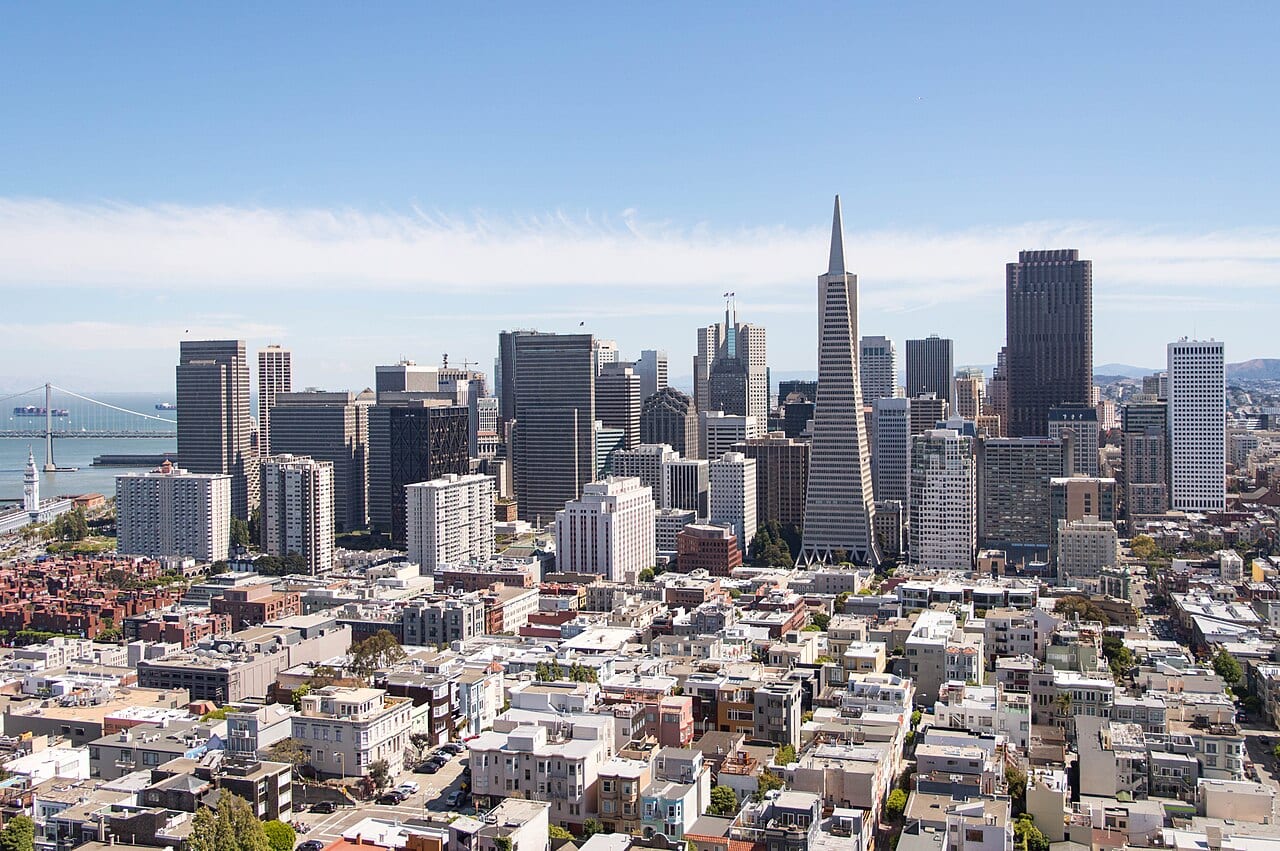
Photo: San Francisco skyline viewed from Coit Tower. Supercarwaar, 2015-07-18. CC BY-SA 4.0 · Source. Resized for web.
How the San Francisco pickup schedule works
Recology’s FAQ says that city ordinance requires all three services at least once a week. It does not offer every-other-week or monthly collection as a reduced option. Collection times can vary, and some commercial areas receive night service.
| Cart | Color and size | How often |
|---|---|---|
| Landfill (trash) | Gray, replacing black; standard 16 gallons, with larger subscriptions available | At least weekly |
| Recycling | Blue; standard residential service 64 gallons | At least weekly |
| Compost | Green; standard residential service 32 gallons | At least weekly |
| Bulky Item Collection | No cart | By appointment |
Use the calendar for your address rather than assuming a nearby building has the same service. If the calendar does not load, call 415-330-1300 or use Recology’s contact page.
Public Works says carts cannot go on the sidewalk or street before 6 p.m. the day before collection. Property owners must retrieve them within 24 hours after putting them out. Businesses must remove them when they open on the following business day. The department warns of fines up to $250 per violation.
Keep lids closed and access clear. Recology advises contacting customer service in advance about extra material; anything that does not fit inside the carts can incur additional charges.
What goes in the San Francisco recycling cart
The three-cart guide requires recycling to be loose, clean and dry, without a plastic-bag liner.
- Yes:
- glass bottles and jars
- aluminum and steel cans
- empty spray cans
- plastic bottles with caps on
- plastic tubs and lids
- plastic clamshells
- clean cardboard
- paper bags
- newspapers and magazines
- milk and juice cartons
- empty clean coffee cups
- No:
- batteries
- electronics
- mirrors and window glass
- ceramics
- Styrofoam
- clothing
- compostable plastic
- food-soiled paper
- light bulbs
Shredded paper is an exception to the loose-paper rule: put it in a sealed paper bag marked “Shredded Paper.” Flatten extra cardboard to a manageable size no greater than 2 by 2 by 2 feet; collection outside the closed cart can cost extra.
Yard waste and food scraps
The green cart takes food scraps, food-soiled paper and plants. Recology lists tree trimmings under 6 inches in diameter and 4 feet long.
- Yes:
- meat and bones
- fruit and vegetable scraps
- coffee grounds and paper filters
- greasy pizza boxes
- paper napkins and towels
- leaves and grass
- flowers
- qualifying tree trimmings
- waxed cardboard
- small pieces of clean untreated wood
- No:
- plastic bags
- cooking oil
- liquids
- diapers
- pet waste
- cartons
- foil
- painted or treated wood
Extra yard trimmings can go beside the green cart in a compostable bag or manageable tied bundle, with additional charges. Food scraps must remain inside the cart. The Christmas-tree guide explains the separate seasonal route; confirm the upcoming season’s dates with Recology before setting out a tree.
Bulk trash pickup in San Francisco
Recology’s Bulky Items page gives buildings with five units or fewer two no-charge curbside collections a year. Each unit in a building with six or more units is eligible for one. An active residential or apartment account is required, and unused collections do not accumulate.
Book through the request form or customer service. Recology’s FAQ asks for at least two weeks’ notice. Each appointment allows up to 10 items.
Set items out between 6 p.m. the night before and 6 a.m. on the appointment day. Attach a paper sign reading RECOLOGY and keep the sidewalk clear. Cancellations must arrive by noon on the business day before collection.
Check the accepted-item list before booking.
- Accepted:
- living-room furniture
- mattresses and foundations
- household refrigerators
- household washers and dryers
- household stoves
- bathroom fixtures
- electronics
- clean bagged or boxed textiles
- Refused:
- ordinary garbage
- cart recyclables
- hazardous waste
- construction debris
- auto parts
- tires
- commercial appliances
- pianos
- items over 100 pounds
Wrap glass, ceramics and mirrors to prevent breakage and injuries. Ask Recology about unusually heavy items before placing them at the curb.
San Francisco holiday trash schedule
The 2026 holiday calendar lists normal collection for Indigenous Peoples’ Day, Veterans Day and Thanksgiving. Recology says Christmas and New Year’s Day are the exceptions to year-round holiday service. Its Christmas 2026 replacement schedule is still marked TBD; do not apply the previous year’s Thursday-to-Friday shift to a Friday holiday.
| Holiday | Date | Collection change |
|---|---|---|
| Indigenous Peoples’ Day | Monday, October 12, 2026 | None; Monday collection as usual |
| Veterans Day | Wednesday, November 11, 2026 | None; Wednesday collection as usual |
| Thanksgiving Day | Thursday, November 26, 2026 | None; Thursday collection as usual; HHW Facility closed Thursday and Friday |
| Christmas Day | Friday, December 25, 2026 | Closed; Friday replacement collection not yet specified; Transfer Station closed, HHW Facility closed Friday and Saturday |
Recheck the official calendar before Christmas. A disposal facility’s holiday closure and a collection route’s schedule are different rules.
Hazardous waste, electronics and drop-off sites
SF Environment says household hazardous waste goes in none of the three bins. Residents can use the HHW Facility or request free home collection by emailing hhw@recology.com or calling 415-330-1405. Home appointments run Wednesday to Saturday mornings and require someone to be present.
The Household Hazardous Waste Facility, 501 Tunnel Avenue, is open Thursday to Saturday, 8 a.m. to 4 p.m. Bring a driver’s license or utility bill proving San Francisco residency. The household limit is 15 gallons or 125 pounds; containers larger than 5 gallons are refused. Keep products separate and in their original containers.
The SF Transfer Station, also at 501 Tunnel Avenue, is open Monday to Friday, 7 a.m. to 4:30 p.m., and weekends, 7:30 a.m. to 4 p.m. Enter on Recycle Road. It closes Christmas Day and New Year’s Day. The current disposal rate is $274.57 a ton with a $60 minimum load charge; surcharges apply to some items.
The station lists no-charge disposal for specified household electronics, clean separated cardboard and Styrofoam. Up to four qualifying mattresses or box springs per day can be accepted without charge when separated and suitable for recycling. Mixed loads and damaged or unsuitable mattresses have different charges.
Fees and billing
The city’s current rate page and Recology’s rates provide the October 1, 2026 to September 30, 2027 residential charges. Houses and buildings with up to five units are generally billed quarterly.
| Monthly charge | October 2026 to September 2027 |
|---|---|
| Base charge per dwelling unit | $21.16 |
| Trash volume, 16 / 32 / 64 gallons | $8.84 / $17.68 / $35.36 |
| Recycling or compost volume, per 32 gallons | $8.84 |
| Trash premium for each 32 gallons above 32 gallons per unit | $14.12 |
| Standard one-unit service: 16 trash, 64 recycling, 32 compost | $56.52 |
The 64-gallon trash volume charge is not the complete bill: the premium and the other services also matter. Recology lists a standard one-unit combination with 64-gallon trash, 64-gallon recycling and 32-gallon compost at $97.16 monthly.
Residential distance service adds $15.12 per cart for each applicable 25-foot increment, elevation service $16.40 per applicable 8-foot increment, and weekly access service $9.50 per cart monthly. Eligible low-income households can apply for a 25% discount. Buildings with six or more units use a different rate structure.
Missed pickup, damaged bins and new bins
- Confirm the service day for your San Francisco address and check the holiday calendar.
- Check that the carts were out early enough, lids closed and access unobstructed.
- Email customerservice@recologysf.com, naming each missed cart and its size or color.
- Use Recology’s contact page or call the provider listed on your bill if you need help.
Recology’s FAQ notes that traffic or route changes can delay collection. Its current residential rate information prices special or return-trip pickup at 25% of the subscribed monthly rate; this should not be treated as an automatic charge for every reported missed cart. Ask customer service about your specific report.
For damaged, missing or differently sized bins, contact Recology. The city rate provisions distinguish ordinary wear from other damage, for which replacement costs may apply.
Materials with their own rules
-
Needles and sharps: containers, designated drop boxes and mail-back.
-
Acetone and bleach: keep leftovers separate and use the household hazardous-waste program.
-
Mattresses: appointment collection or qualifying separated drop-off.
-
Household hazardous waste: resident drop-off and home collection.
-
Paint: hazardous-waste and participating retail routes.
-
Household batteries: separate collection routes.
-
Lithium-ion batteries: protect terminals and check the battery type.
-
Vapes and e-cigarettes: none of the three bins; the HHW Facility or home collection.
-
Light bulbs: different rules for fluorescent and other lamps.
-
Styrofoam: excluded from the blue cart; transfer-station recycling available.
-
Pizza boxes: greasy boxes go green.
-
Christmas trees: seasonal collection requires its own dates.
-
Tires: transfer-station surcharges.
-
Aerosol cans and propane tanks: distinguish empty spray cans from cylinders.
-
Helium tanks: a separate disposal route.