
A used lithium-ion battery still holds enough charge to start a fire if it is crushed in a truck or on a sorting line. That is why the U.S. Environmental Protection Agency tells households not to put these batteries — or devices that still contain them — in the garbage cart or the curbside recycling bin.
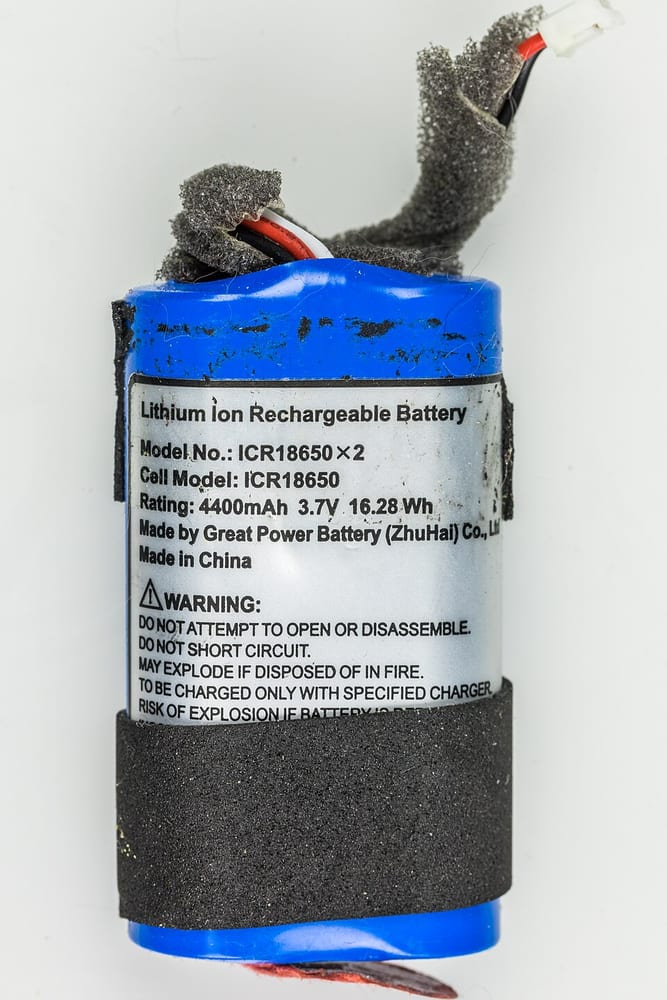
Photo: A cylindrical ICR18650 lithium-ion battery removed from a portable speaker. Raimond Spekking, 2022-02-10. CC BY-SA 4.0 · Source. Resized for web.
The agency last updated its Used Lithium-Ion Batteries page on March 20, 2026. Take them to a battery recycler, a participating retailer, or a household hazardous waste collection point.
What counts here
Lithium-ion packs show up in phones, laptops, tablets, cordless tools, cameras, e-readers, toys and e-cigarettes. Some packs come out with a clip. Others stay sealed inside the device. Both belong in a separate collection stream.
If the word lithium is printed on a single-use button or coin cell, EPA also says to keep that cell out of trash and municipal recycling. Rechargeable nickel-cadmium and nickel-metal hydride cells have the same drop-off recommendation on the used household batteries page.
How to pack them
- Cover the terminals with non-conductive tape, such as electrical tape, and keep the label readable.
- Or put each battery, or each device that still holds a battery, in its own plastic bag.
- Do not toss loose cells into a box with coins, keys or other batteries.
Swollen, leaking or damaged batteries
A puffed-up phone or laptop pack, a cracked power-tool battery or a cell that leaks is still a lithium-ion battery: it does not go in the trash or the recycling cart either. EPA’s instruction for a damaged battery is to contact the battery or device maker for its specific handling advice, and it warns that even used batteries can hold enough energy to injure someone or start a fire. Do not try to pry a sealed pack out of a device; EPA notes that not every battery is removable by the user.
Bag and tape it like any other lithium battery, then take it to a household hazardous waste site that accepts lithium batteries. In King County and Seattle, the county’s hazardous waste collection sites take lithium and other rechargeable batteries, up to 25 pounds for a single battery, at no fee. Seattle has banned batteries from garbage and recycling containers since January 1, 2024, and offers a paid Special Item Pickup for account holders instead.
Where to take them
Start with the city guide on this site: States & Cities and drop-off locations. Two worked examples already on file: Austin takes electronics and household hazardous waste at the Recycle and Reuse Drop-off Center by appointment, and Middlebury, Connecticut accepts universal waste and rechargeable batteries at the transfer station with no disposal charge.
EPA also points households to Call2Recycle and the Earth911 lithium-ion search. Confirm hours and residency rules. Those locators are not a Trashbagging integration — see our Call2Recycle listing for what the program is and is not.
The federal household-hazardous-waste exemption does not make the cart a safe place for lithium cells. State and city programs still set the drop-off. Related: household hazardous waste, household batteries.


