
How to dispose of household batteries depends on the chemistry and on your state. The EPA says ordinary alkaline batteries can go in the household trash in most communities, but rechargeable, lithium and button batteries should never go in the trash or the recycling cart. California, Washington, DC and Seattle ban every battery from the trash.
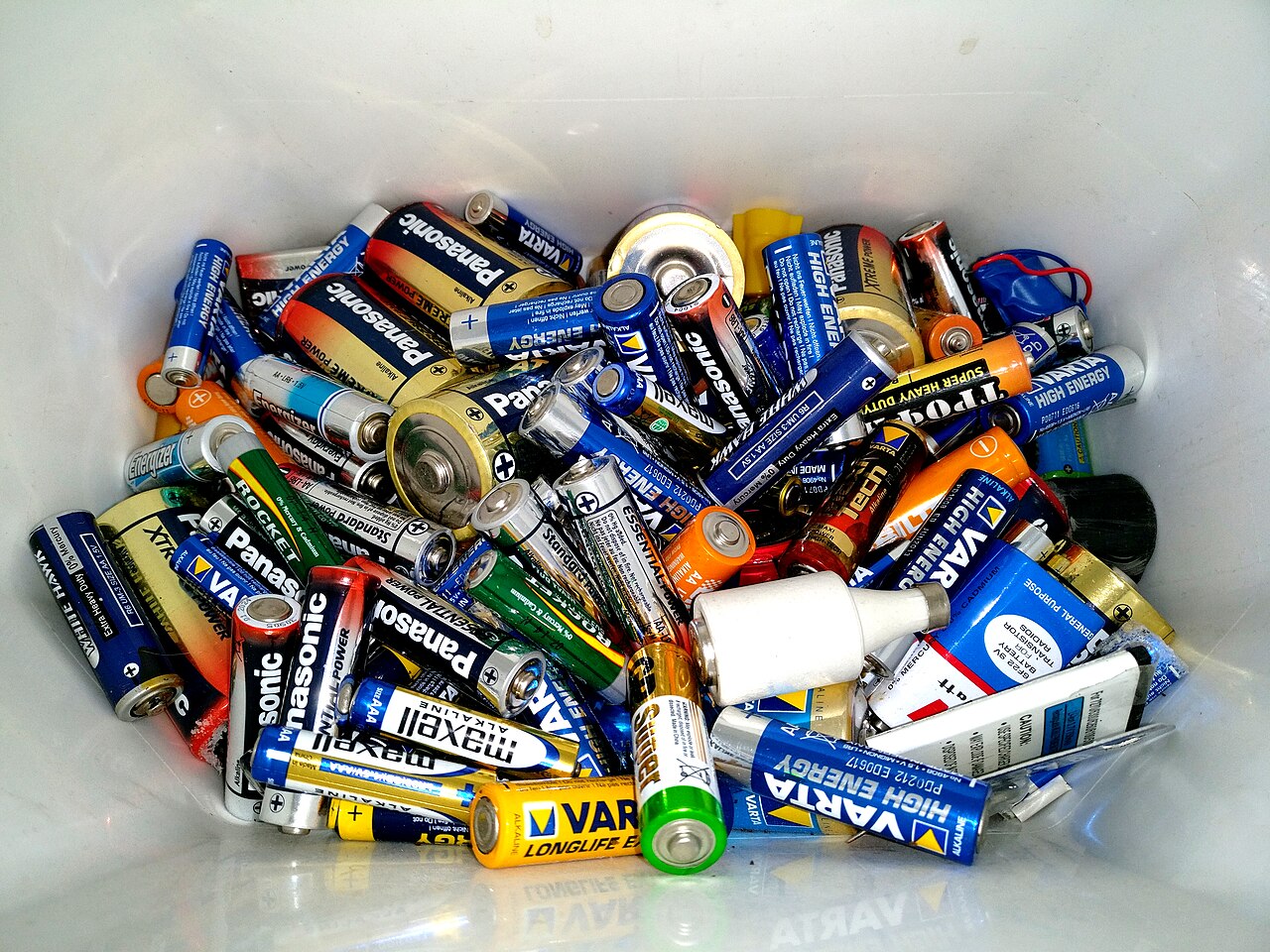
Photo: Used household batteries in a battery recycling bin. Santeri Viinamäki, 2016-09-05. CC BY-SA 4.0 · Source. Resized for web.
Start by reading the label, not the shape. The EPA notes that battery types are identified by their marking, not by size or label color. Alkaline and zinc-carbon cells are the everyday AA, AAA, C, D and 9-volt batteries. Rechargeables are marked lithium-ion (Li-ion), nickel-metal hydride (NiMH), nickel-cadmium (NiCd) or sealed lead-acid. Coin and button cells are the small round batteries in watches, key fobs and hearing aids, and most of them today are lithium.
What is true everywhere
- Rechargeables never go in the trash or the cart. The EPA says not to put rechargeable batteries, including lithium-ion, NiMH, NiCd and small sealed lead-acid batteries, in household garbage or municipal recycling bins.
- Lithium and button cells stay out too. The EPA says not to put button-cell, coin or lithium single-use batteries in the trash or recycling bins. Check the battery for the word “lithium”.
- Alkaline batteries are the one exception, in most places. The EPA says alkaline and zinc-carbon batteries can safely go in household trash in most communities, while recommending a battery recycler or your local solid waste authority first.
- Tape before you store or drop off. The EPA asks you to put each battery in its own plastic bag, or cover the terminals with non-conductive tape such as electrical tape, because a battery can still spark and start a fire when it looks dead. For a button cell, tape around the whole button.
- Households are treated differently from businesses. Under federal hazardous waste law, waste that households throw out is generally exempt, and the EPA recommends that businesses manage lithium-ion batteries under the universal waste rules. States and cities can be stricter for households, and several are.
- Keep button cells away from children. The Consumer Product Safety Commission warns that a swallowed button battery can burn through a child’s throat in as little as two hours. Store used ones out of reach until drop-off.
States that ban batteries from the trash
- California: the Department of Toxic Substances Control says old batteries cannot go in the trash or household recycling bins, because it is prohibited by law. That covers alkaline AA, AAA, C, D, 9-volt and button batteries as well as rechargeables. Stores that sell rechargeable batteries must take them back.
- Washington, DC: since August 1, 2023, D.C. Official Code § 8-771.09 bans single-use and rechargeable household batteries from the trash. The District’s battery stewardship program, run by The Battery Network (formerly Call2Recycle), began on November 1, 2023.
- New York: the Department of Environmental Conservation says it is illegal to throw covered rechargeable batteries in the trash. Stores that sell them must accept up to 10 a day from anyone.
- Minnesota: the Minnesota Pollution Control Agency says rechargeable batteries, and products with built-in rechargeable batteries, may not go in mixed municipal waste.
- Vermont: the Vermont Battery Stewardship program recycles single-use and rechargeable batteries free.
- Laws starting later: Illinois made battery producers join a stewardship plan from January 1, 2026, and from January 1, 2028 state law requires everyone to send unwanted covered batteries to a collection site and keeps them out of landfills and the recycling stream. Washington collection sites begin taking portable batteries on July 1, 2027. Colorado says its program will begin collecting batteries in 2028.
Where it turns local
Seattle: every battery is banned from the garbage
- In Seattle, Washington, Seattle Public Utilities Director’s Rule SW-404 bans batteries from any residential or commercial garbage or recycling container. The ban names button cells, alkaline and other single-use batteries, and lithium-ion, nickel-cadmium and other rechargeables. A battery seen in a cart brings a tag asking you to take it out.
- Drop household batteries, ends taped, at the North Seattle Hazardous Waste Facility, 12550 Stone Avenue North, Sunday to Tuesday 9 a.m. to 5 p.m., or the South Seattle Hazardous Waste Facility, 8100 2nd Ave S, Thursday to Saturday 9 a.m. to 5 p.m. Both are free for King County residents.
- Seattle account holders can also book a Special Item Pickup for up to two 1-gallon bags of household batteries, ends taped: the first pickup each year is free, then $5, online or at (206) 684-3000.
Honolulu: alkaline in the gray cart, rechargeables to a city site
- In Honolulu, Hawaii, the city’s Department of Environmental Services says regular alkaline batteries, AA, AAA, D, 9-volt, disc and button, can go in the regular trash.
- Loose lithium, lithium-ion, NiMH and NiCad batteries go to any city convenience center or transfer station, terminals taped, in a clear plastic bag. The seven convenience centers, such as the Kapolei Convenience Center, are open daily 7 a.m. to 6 p.m. and free for residents.
- Devices with built-in batteries go to the city’s appointment-only household hazardous waste events instead.
Washington, DC: free drop-off at the farmers markets
- In Washington, DC, no household battery may go in the trash. The Department of Energy and Environment runs free battery collection at Zero Waste DC tents at farmers markets in all eight wards through late December 2026, such as Eastern Market on Saturdays 9 a.m. to 1 p.m. and Dupont Circle on Sundays 8:30 a.m. to 1:30 p.m. Damaged and defective batteries are accepted there too.
- The Department of Public Works also takes alkaline and rechargeable batteries at its registered household hazardous waste events for DC residents, with terminals taped or bagged.
How to find your local answer
- Read the battery’s label. If it says lithium, Li-ion, NiMH, NiCd or lead, it needs a drop-off everywhere.
- Check whether your state is one of those above. If it is, alkaline batteries need a drop-off too.
- Open your city or county page from States & Cities and look under hazardous waste and drop-off sites, or search the drop-off locations catalog.
- Use The Battery Network’s drop-off locator ↗, which the state programs in DC and Washington point residents to.
What this is not
- Car batteries. A vehicle’s lead-acid starter battery is not a household battery and has its own take-back rules; keep it out of household battery bins.
- Devices with built-in batteries. A phone, laptop, vape or power tool with a battery that does not come out goes to an electronics or hazardous waste drop-off as a whole device. See lithium-ion batteries.
- Recycling-cart items. No battery belongs in the curbside recycling cart, in any of the places covered here.


