
- Who collects: Honolulu Environmental Services, for about 160,000 homes on automated three-cart routes and about 20,000 on manual, refuse-only routes
- Your pickup day: depends on your address; View Your Cart Collection Schedule on HNL.INFO ↗
- Holiday changes: no collection only on Christmas Day and New Year’s Day; Holiday Ōpala Alerts ↗
- Missed pickup: leave the cart at the curb and call your collection yard; Report a Missed Pick Up ↗
- Contact: (808) 768-3200, collection@honolulu.gov
- Official website: ENV Refuse Division (Ōpala) ↗
The Honolulu trash pickup schedule is set by Honolulu Environmental Services, the city’s Department of Environmental Services (ENV). The gray refuse cart goes every week. The blue recycling and green carts take turns on a second day, so each goes every other week, and since October 1, 2026 food scraps can go in the green cart islandwide. Find your two collection days on HNL.INFO.
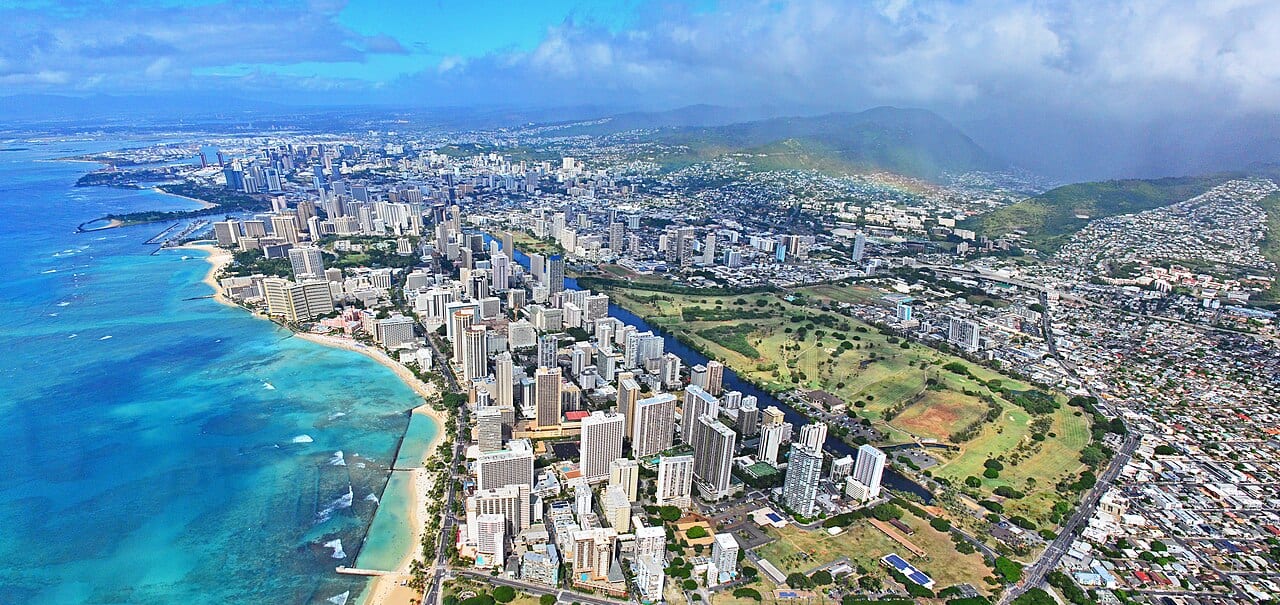
Photo: Aerial panorama of Waikiki and Honolulu. Edmund Garman, 2014-12-11. CC BY 2.0 · Source. Resized for web.
How the Honolulu pickup schedule works
Every home on the three-cart system has a pair of collection days: Monday and Thursday, Tuesday and Friday, or Wednesday and Saturday. One day is for the gray refuse cart. The other is for recycling, with the blue cart one week and the green cart the next. In some areas the first day of the pair is for recycling and the second for refuse; in others it is the reverse.
| Cart | Color and size | How often |
|---|---|---|
| Refuse | Gray | Weekly |
| Recycling | Blue; 64 or 94 gallons | Every other week |
| Green waste and food scraps | Green | Every other week, alternating with blue |
| Bulky items | No cart | By appointment, once a month (weekly in Waikīkī) |
- Set-out. Carts go to the curb by 6 a.m., but not before 6 p.m. the evening before, and back onto your property after collection.
- Placement. Leave at least 5 feet of clearance from fences, lampposts, hydrants, mailboxes and parked cars. Keep the lid closed and stay under the 75-pound limit; a driver empties each cart once per collection day.
- Manual routes. About 20,000 homes on streets too narrow for automated trucks use their own cans of up to 35 gallons and 75 pounds, with lids left untied. ENV’s holiday notices call this twice-a-week refuse collection. These homes have no curbside recycling yet.
- Apartments and condos. Follow your property manager’s directions. A building not on city collection must have a licensed collector, or the owner, haul its refuse at least weekly. ENV’s Condo Recycling Program lends up to 20 wheeled carts and reimburses up to $2,000 of recycling start-up costs when funds allow.
What goes in the Honolulu recycling cart
Everything goes in loose: do not bag, tie or bundle recyclables, and rinse containers. ENV’s Blue, Green, Gray Sorting ↗ page is the official list.
- Yes:
- aluminum and steel cans
- glass bottles and jars, lids removed
- newspaper without glossy inserts
- flattened corrugated cardboard
- plastic containers numbered 1 or 2, lids removed
- white and colored office paper
- paper bags
- No:
- plastics numbered 3 to 7
- plastic bags and foam
- junk mail, magazines and phone books
- envelopes and shredded paper
- cereal boxes, tissue boxes and other single-layer board
- paper plates and napkins
- dishes, drinking glasses, window glass and mirrors
- light bulbs
- lids and caps
Holiday wrapping paper, cards and glossy gift bags go in the gray cart too. The list is short on purpose: ENV sends low-value plastic and paper to H-POWER, the city’s waste-to-energy plant, which makes about 7 percent of Oʻahu’s electricity. Homes without curbside recycling can use the city’s blue bins at the Waialua Refuse Collection Yard, 62-126 Emerson Road, Haleʻiwa, and at Kawailoa Transfer Station.
HI-5 deposit containers
Hawaii adds a 5¢ refundable deposit and a 1¢ non-refundable fee to each beverage container with the HI 5¢ label. The deposit covers aluminum, bi-metal, glass, and #1 or #2 plastic containers of up to 68 fluid ounces holding soda, water, juice, tea, coffee drinks, sports drinks or beer; milk, wine, spirits, pouches and cartons are out. Redeem them at a certified center from the state Department of Health’s Find A Redemption Center ↗ map or ENV’s list of HI-5 redemption centers ↗. Centers must count up to 200 containers if you ask; take caps off for loads paid by weight. Operators set their own hours, so the state suggests calling first. HI-5 containers can also go in the blue cart, without the refund.
Yard waste and food scraps
Under G.R.O.W. (Green Recycling Organic Waste) ↗, food scraps share the green cart with yard waste. The program started April 1, 2026 in six areas and went islandwide on October 1, 2026 for every home with the automated three-cart system. It uses the same green cart on the same day, and taking part is voluntary. Put everything in loose: plastic bags contaminate the compost at Hawaiian Earth Recycling.
- Accepted:
- grass clippings and leaves
- branches, hedge trimmings and palm fronds
- natural Christmas trees without ornaments or flocking
- fruits and vegetables
- dairy solids such as cheese and yogurt
- bread, pasta, rice, grains and cereal
- beans, nuts and seeds
- meat, seafood, poultry and bones
- eggshells, nutshells and seafood shells
- leftovers, spoiled food and plate scrapings
- loose coffee grounds and tea leaves
- Refused:
- liquids
- fats, oils and grease
- paper and paper products
- coffee cups, takeout containers, fast food wrappers and pizza boxes
- any plastic, including bags
- items labeled compostable or biodegradable
- metal and glass
- pet waste
- corks, rubber bands, produce stickers and twist ties
- dirt, rocks, bricks and plant pots
ENV suggests freezing scraps until collection day and tipping them in loose; kitchen pails and questions go through (808) 768-3200 or opala@honolulu.gov. Apartments and condos are not on G.R.O.W., but their residents may take food scraps and green waste free to Hawaiian Earth Recycling in Wahiawā. City convenience centers and transfer stations take green waste, not food scraps.
Christmas trees go in the green cart cut into lengths of up to 3 feet, or whole to any convenience center except Wahiawā, Kapaʻa Transfer Station or Hawaiian Earth Recycling. Bulky appointments are not taken for natural trees. The first six G.R.O.W. areas are told in Honolulu’s G.R.O.W. pilot puts food scraps in the green compost cart.
Bulky trash pickup in Honolulu
Bulky items go by appointment only: book on ENV’s Bulky Item Pick Up Appointment ↗ page or call (808) 768-3200, option 0. One appointment per address per month; Waikīkī residents can book weekly.
- Up to five bulky items per appointment, plus up to two metal appliances, for each single-family home or apartment unit. A building’s association or manager can book up to 20 items and 8 appliances for the whole building through collection@honolulu.gov.
- List every item; crews leave anything not booked.
- Set items out no earlier than 6 p.m. the evening before and by 6 a.m., at the curb in front of your property without blocking the sidewalk, driveway or drains; apartments use the building’s common pickup spot.
- Long items and bundles are capped at 6 feet and 60 pounds. Putting bulky items out on any other day is illegal.
What an appointment refuses:
- Refused:
- tile, drywall and other construction or demolition debris
- dirt, rock and concrete
- large auto parts
- household hazardous waste
- regular trash and recycling
Mattresses, furniture and carpet can go by appointment or free to a city drop-off site. For qualifying refrigerators and freezers, ENV points to Hawaii Energy’s Rid-A-Fridge rebate and free haul-away.
Honolulu holiday trash schedule
ENV refuse crews observe only two holidays a year: Christmas Day and New Year’s Day. On those days nothing is collected, bulky items included. A gray cart due that day stays at the curb until it is serviced; blue and green carts are not made up and wait for the next scheduled pickup. Convenience centers, transfer stations and the landfill close both days. Every other holiday is a regular collection day.
| Holiday | Date | Collection change |
|---|---|---|
| General Election Day | Tuesday, November 3, 2026 | None; regular collection |
| Veterans’ Day | Wednesday, November 11, 2026 | None; regular collection |
| Thanksgiving | Thursday, November 26, 2026 | None; regular collection |
| Christmas | Friday, December 25, 2026 | Closed; gray carts stay out until serviced, blue and green carts wait for the next pickup, drop-off sites closed |
| New Year’s Day | Friday, January 1, 2027 | Closed; gray carts stay out until serviced, blue and green carts wait for the next pickup, drop-off sites closed |
After New Year’s Eve, soak fireworks in water overnight, break them in half, bag them and put them in the gray cart while still wet.
Hazardous waste, electronics and drop-off sites
Household hazardous waste has no permanent drop-off site. ENV holds appointment-only drop-off events about every two months; the next is Saturday, November 7, 2026, with registration closing October 29 or when 200 appointments fill. Register at (808) 768-3201 or hhw@honolulu.gov with a list of items and container sizes and a preferred drop-off time between 9 a.m. and 11:45 a.m. Only registered items are taken, up to 12. The Household Hazardous Waste ↗ page lists the event dates.
- Events: pesticides, gasoline, kerosene and other fuels, antifreeze, solvents and thinner, aerosol, lead and aluminum paint, CFL bulbs and fluorescent tubes, mercury, muriatic and hydrochloric acid, and devices with built-in batteries.
- Gray cart: latex and oil paint once dried or absorbed, motor oil soaked into an oil-change box, household alkaline batteries, ordinary light bulbs, and sharps in a rigid screw-top container.
- Rechargeable batteries: loose lithium, lithium-ion, NiMH and NiCad batteries go to any convenience center or transfer station, terminals taped, in a clear plastic bag. Car batteries go back to the retailer or to a city site.
- Electronics: every convenience center and transfer station has an e-waste bin for computers, laptops, tablets, TVs, printers, cords, routers, speakers and game consoles, but not phones or GPS units.
- Gas cylinders: household propane, butane, MAPP and helium tanks and home fire extinguishers go to any convenience center, Kapaʻa or Kawailoa, never in the trash.
City drop-off sites are free for residents, with two loads a day across all sites, Hawaiian Earth Recycling included. Cars, SUVs, pickups and minivans only; trailers need approval from disposal@honolulu.gov. Cut material to under 6 feet and 60 pounds. Limits: two large appliances and four passenger or light-truck tires a month.
Convenience centers are for residents only, open daily 7 a.m. to 6 p.m. They take household rubbish, bulky items, large appliances, green waste, tires, gas cylinders, batteries and e-waste.
- Waimānalo, 41-241 Hihimanu Street, (808) 259-7182
- Waiʻanae, 85-572 Waiʻanae Valley Road, (808) 696-4203
- Waipahu, 94-071 Waipahu Depot Street, (808) 676-8878
- ʻEwa Beach, 91-1000 Geiger Road, (808) 226-2996
- Kapolei, 91-184 Kaomi Loop, (808) 260-2801
- Lāʻie, 56-020 Kamehameha Highway, (808) 293-8714
- Wahiawā, 71-129 Wilikina Drive, (808) 621-3648; no green waste
Transfer stations and other sites:
- Kapaʻa Transfer Station, 100 Kapaʻa Quarry Road, Kailua, (808) 768-4248. Monday to Friday 10 a.m. to 6 p.m., weekends 7 a.m. to 6 p.m. Takes everything the convenience centers do, plus dirt, rock, concrete and tile (five 5-gallon buckets a day) and drywall (4 sheets a day).
- Kawailoa Transfer Station, 62-180 Kawailoa Road, Haleʻiwa, (808) 637-5511. Daily 7 a.m. to 6 p.m. Household trash, bulky items, appliances, tires, batteries and gas cylinders; green waste only on Saturdays and Sundays, and not composted.
- Keʻehi Transfer Station, 606 Middle Street, Honolulu, (808) 768-4884. Monday to Friday 10 a.m. to 6 p.m., Saturday 7 a.m. to 6 p.m., closed Sunday. Household trash, combustible bulky items, metal and batteries; no large appliances, tires or gas cylinders.
- Hawaiian Earth Recycling, 65-1101 Wilikina Drive, Wahiawā, (808) 682-5895. Monday to Saturday 7 a.m. to 4:30 p.m., Sunday 8 a.m. to noon. Green waste and food scraps, free for residents.
- Waimānalo Gulch Sanitary Landfill, 92-460 Farrington Highway, Kapolei, (808) 668-2985. Monday to Saturday 7 a.m. to 4:30 p.m. For residents, only dirt, rock, sand, gravel, concrete and dead animals, up to two pickup loads a day.
Fees and billing
Curbside collection is paid for by the city: the Real Property Assessment Division names refuse among the services the real property tax funds. Extra carts and resident drop-off cost nothing. Under city ordinance, an owner pays $75 for a cart replaced because of intentional damage. Businesses need a city disposal account, (808) 768-3410, or a private hauler.
Missed pickup, damaged carts and new carts
- Check for a tag. If the crew left one, fix the problem it names, such as a blocking car, too much weight or the wrong material; the cart is picked up on your next collection day.
- With no tag, leave the cart at the curb.
- Call your collection yard from the table below.
| Collection yard | Areas | Phone |
|---|---|---|
| Honolulu | Foster Village to Hawaiʻi Kai | (808) 768-5990 |
| Kailua | Kailua, Temple Valley, Kāneʻohe, Waimānalo | (808) 768-5995 |
| Lāʻie | Kahuku to Kahaluʻu | (808) 768-9748 |
| Pearl City | Hālawa to Makakilo, Pearl City, Waipahu, Waipiʻo Gentry, Royal Kunia, Kapolei, ʻEwa Beach | (808) 768-9732 |
| Wahiawā | Wahiawā, Kunia Camp, Mililani, Waipiʻo Acres | (808) 768-9766 |
| Waialua | Waialua, Haleʻiwa, Sunset | (808) 768-9750 |
| Waiʻanae | Mākaha to Honokai Hale | (808) 768-3596 |
A missed bulky appointment, with the booked items out by 6 a.m., goes to collection@honolulu.gov or (808) 768-3200. The collection yard repairs wheels and hinges or replaces a broken cart, which must be empty; report a stolen cart to the Honolulu Police Department first, then give the yard the report number. A new home starts service through (808) 768-3200 or collection@honolulu.gov.
Extra carts are free, up to five per property, but ENV takes no requests from October 1, 2026 to January 31, 2027 because of holiday service needs. A second green cart needs a lot of at least 10,000 square feet (8,000 in Waiāhole, Waikāne, Kahaluʻu, Mānoa, Nuʻuanu and Kāneʻohe mauka of Kamehameha Highway). Extra blue carts, or a swap from 64 to 94 gallons, need a steady surplus of recyclables. A second gray cart needs a period of trash monitoring first. Details are on About Your Carts ↗.
Set-out rules and fines
- Bag refuse, drain and wrap food waste that goes in the gray cart, and wrap broken glass. No liquids, concrete, construction debris, soil or rocks in any cart.
- If someone in your home had radioactive medical treatment, call your collection yard before throwing out tissues or diapers; staff test them at your house.
- Report carts or bulky items left out to Refuse Inspectors at (808) 768-5220, and illegal dumping to (808) 768-3203.
- City ordinance sets civil fines of up to $500 per violation, each day counting separately, and up to $2,500 for dumping refuse or bulky items on a street or public place.
Materials with their own rules
- Lithium-ion batteries: loose ones to any convenience center or transfer station, terminals taped.
- Household batteries: alkaline batteries in the gray cart; rechargeables taped, in a clear bag, to a convenience center or transfer station.
- Light bulbs: ordinary bulbs in the gray cart; CFLs and fluorescent tubes to a hazardous waste event.
- Household hazardous waste: appointment-only events, up to 12 items.
- Old gasoline: a hazardous waste event, by appointment.
- Paint: dried latex and oil paint in the gray cart; aerosol, lead and aluminum paint to an event.
- Cooking oil and grease: absorbed and bagged in the gray cart, never in the green cart.
- Styrofoam: the gray cart.
- Mattresses: bulky appointment or a city drop-off site.
- Pizza boxes: never in the green cart, even under G.R.O.W.
- Pumpkins: the green cart, loose, on three-cart routes.
- Christmas trees: green cart in 3-foot lengths, or whole to most drop-off sites.
- Tires: four a month at city sites except Keʻehi.
- Aerosol cans and propane tanks: propane to a convenience center, Kapaʻa or Kawailoa.
- Helium tanks: never in the trash; a convenience center, Kapaʻa or Kawailoa, not Keʻehi.