
How to dispose of light bulbs depends on what is inside them. LED, incandescent and halogen bulbs hold no mercury, and cities such as Seattle send them to the garbage. CFLs and fluorescent tubes do hold mercury: the EPA asks everyone to recycle them, and six states ban them from landfills outright.
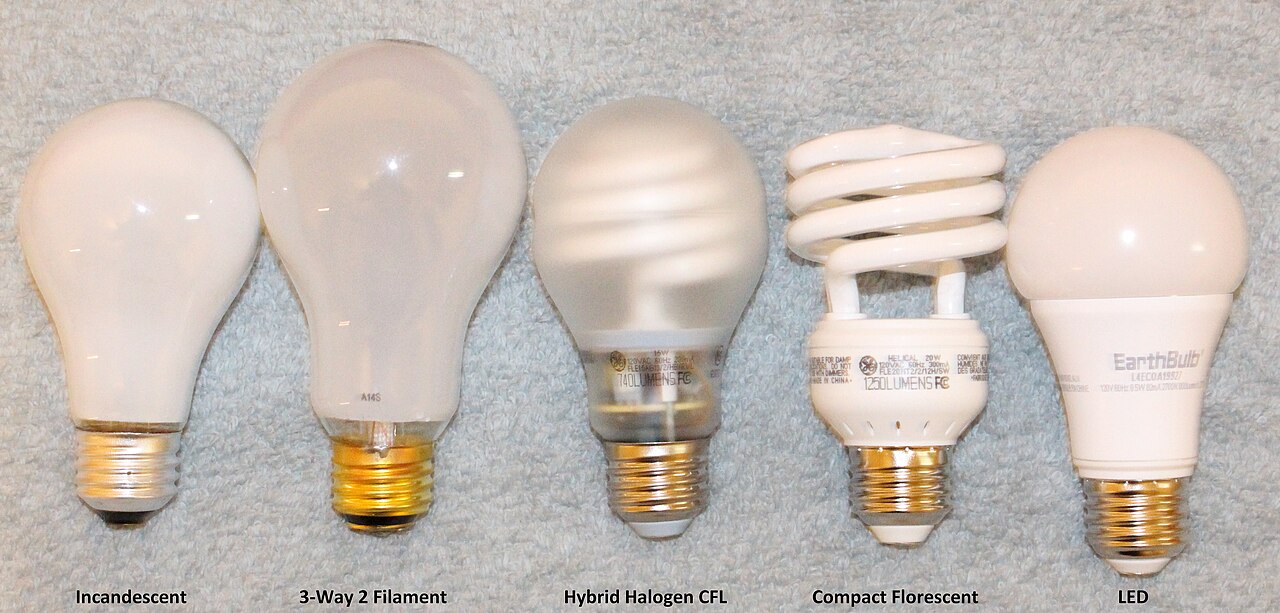
Photo: Incandescent, three-way, hybrid halogen, compact fluorescent and LED light bulbs. Mark jurrens, 2014-11-06. CC BY-SA 4.0 · Source. Resized for web.
The first job is telling the bulbs apart. A compact fluorescent lamp (CFL) is the spiral or folded glass tube. Fluorescent tubes are the long straight, U-shaped or circular lamps in kitchen and garage fixtures. Black lights, tanning bulbs and high-intensity discharge lamps are mercury bulbs too. An LED bulb usually has a plastic or frosted dome over a heavy base, and an incandescent or halogen bulb has a visible filament.
What is true everywhere
- Mercury bulbs need a separate path. The EPA says CFLs contain about four milligrams of mercury on average, sealed inside the glass. No mercury escapes while the bulb is whole, but it can when the bulb breaks in a trash can, a truck or a landfill. That is why the EPA recommends recycling CFLs, fluorescent tubes and every other mercury bulb rather than putting them in household trash.
- Federal law exempts households, not bulbs. Under the EPA’s household hazardous waste exclusion, a household’s used lamps are exempt from the federal hazardous waste rules; businesses must manage mercury lamps as universal waste. The EPA still encourages households to recycle, and states can be stricter.
- Where the trash is allowed, seal it. If your state and city permit a used or broken CFL in the trash, the EPA says to seal it in a plastic bag and put it in the outside trash for the next collection.
- Keep them whole. Store used fluorescent bulbs in a box that stops them breaking, such as the original packaging. Recyclers generally want them unbroken.
- LED, incandescent and halogen bulbs contain no mercury. Vermont’s Department of Environmental Conservation lists all three as bulbs you may put in the trash, and Seattle Public Utilities sends incandescent and LED bulbs to the garbage. None of them goes in the recycling cart in the cities below.
States that ban mercury bulbs from the trash
The EPA lists six states that prohibit mercury-containing lamps from landfills: California, Maine, Massachusetts, New Hampshire, Vermont and Washington. Minnesota has its own law.
- California: the Department of Toxic Substances Control says mercury-containing lamps may not go in the trash or in household recycling bins; it is prohibited by law, and households must recycle them.
- Minnesota: state law requires fluorescent and high-intensity discharge lamps to go to a lamp recycling facility, which includes household hazardous waste sites, retailer take-back and utility collection sites. The Minnesota Pollution Control Agency says all fluorescent lamps are banned from the trash.
- Maine: the Department of Environmental Protection says it is illegal to throw mercury-added bulbs in the trash. Collection sites take unlimited CFLs and up to 10 tubes or other mercury lamps per visit.
- Vermont: fluorescent, compact fluorescent, black light, HID, ultraviolet and neon bulbs are banned from the trash. The state collects unlimited CFLs and up to 10 tubes a day from residents free.
- Washington: state law says no mercury-containing lights may knowingly go in waste containers bound for landfills or incinerators. The Department of Ecology says the program’s operator has left and there is no approved stewardship plan, so it asks residents to call their local solid waste department and to call before going to a drop-off.
Where it turns local
Seattle: garbage for LEDs, hazardous waste sites for fluorescents
- In Seattle, Washington, Seattle Public Utilities’ sorting guide says incandescent and LED bulbs go in the garbage.
- Fluorescent bulbs and tubes go to the city’s two household hazardous waste facilities, which are free for all King County residents with no appointment: the North Seattle Hazardous Waste Facility at 12550 Stone Avenue North, open Sunday to Tuesday 9 a.m. to 5 p.m., and the South Seattle Hazardous Waste Facility at 8100 2nd Ave S, open Thursday to Saturday 9 a.m. to 5 p.m.
- Seattle’s transfer stations do not take household hazardous waste.
Denver: never the trash or the recycling cart
- In Denver, Colorado, the city says CFLs and fluorescent tubes must never go in the trash or recycling bins because they contain mercury.
- The city points residents to hardware stores: Home Depot and Lowe’s have CFL bins at most locations, usually in the lighting department, and most stores take twisty CFLs but not long tubes. Blue Star Recyclers takes CFLs and tubes for a fee.
- Denver’s Household Hazardous Waste At-Your-Door program collects fluorescent bulbs and tubes at home. Residents get one appointment a year with a $15 co-payment, and a pickup needs at least three types of material or one material over 25 pounds. Book at 1-800-449-7587.
Phoenix: the yearly hazardous waste pickup
- In Phoenix, Arizona, fluorescent and CFL bulbs are on the city’s household hazardous waste list. Solid waste customers get one free home collection a year: put the bulbs in a box marked “HHW” beside the garage or front door, never at the curb.
- Light bulbs are on the city’s list of items that do not go in the blue recycling container.
- Phoenix transfer stations do not take hazardous waste.
How to find your local answer
- Check whether you live in one of the states above. If you do, mercury bulbs cannot go in the trash.
- Open your city or county page from States & Cities and look under hazardous waste and drop-off sites. Many cities take fluorescent bulbs at a hazardous waste facility or on a home pickup.
- Search the drop-off locations catalog for a household hazardous waste facility near you.
- Before you drive to a store, call ahead. The EPA notes that not every store in a chain takes bulbs, and some take CFLs but not 4-foot tubes.
If a CFL breaks
The EPA’s cleanup steps: get people and pets out of the room, open a window or door to the outdoors and shut off central heating or air conditioning. Do not vacuum unless glass remains after everything else. Scoop up glass and powder with stiff paper or cardboard, pick up small pieces with sticky tape, and wipe hard surfaces with a damp paper towel. Seal everything in a glass jar with a metal lid or a sealable plastic bag and take it outdoors. Then check your local rules: some places require broken bulbs to go to a recycling or hazardous waste site; where they do not, the EPA says the sealed debris can go in the household trash. For questions, call poison control at 1-800-222-1222.
What this is not
- Batteries. A bulb is not a battery; lithium-ion batteries have their own rules and cause truck fires.
- Other household hazardous waste. Mercury thermostats and thermometers also contain mercury but are separate items on hazardous waste lists; see household hazardous waste.
- Glass recycling. A light bulb is not a glass jar. It stays out of the recycling cart, whatever the type.


