
How to dispose of antifreeze is simple to state: never down a drain, into a storm drain or onto the ground, and not in a trash or recycling cart. Used antifreeze goes to a household hazardous waste drop-off or a business that recycles it. No federal rule tells a household what to do with it, so the place to take it is set by your city or county.
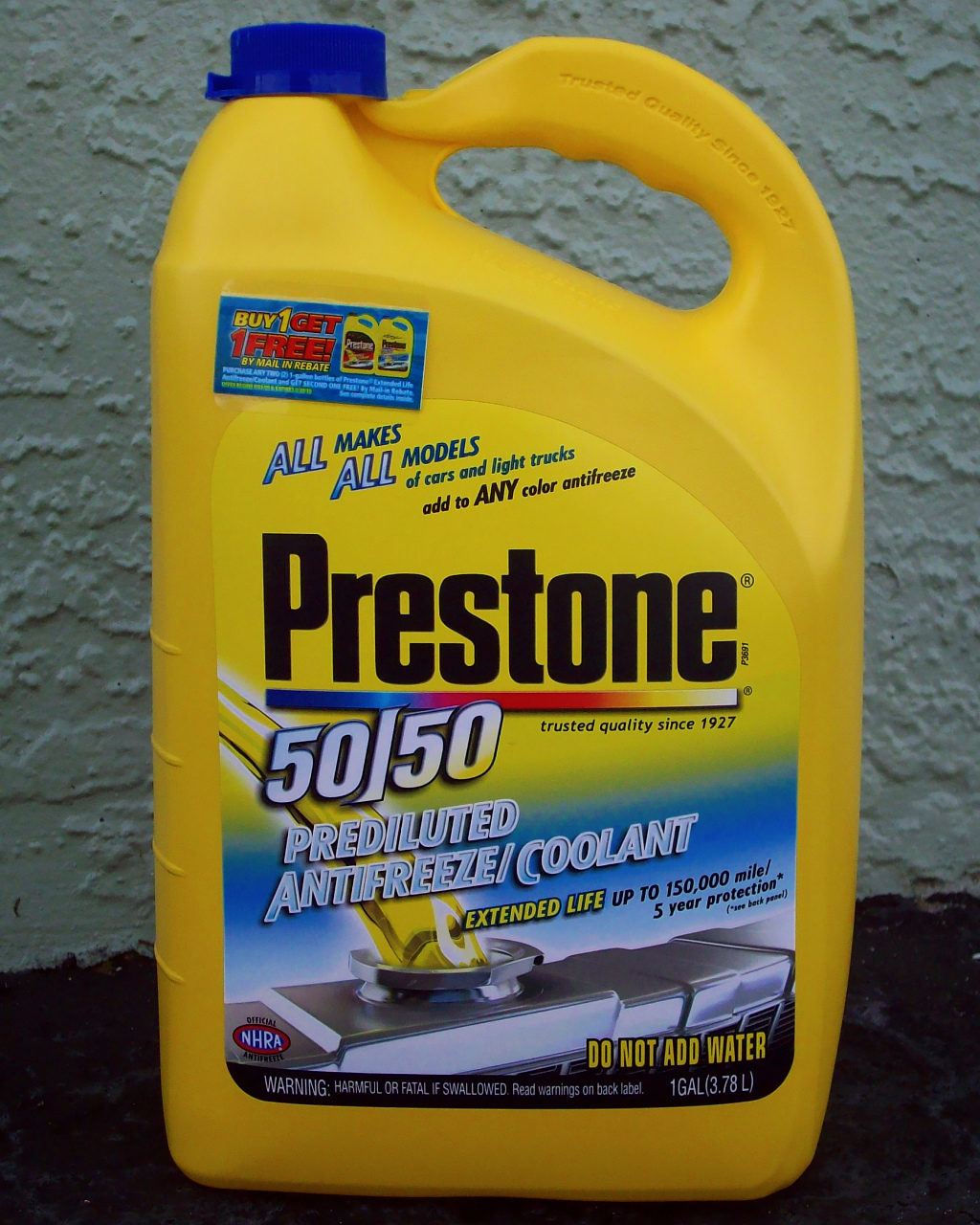
Photo: A plastic bottle of ethylene glycol antifreeze. dno1967, 2009-12-07. CC BY 2.0 · Source. Resized for web.
Antifreeze, also sold as engine coolant, is most often made of ethylene glycol. The US EPA calls it toxic to humans and animals, and used coolant can also carry dissolved heavy metals picked up in the engine. Its sweet taste is what makes a spill or an open jug dangerous to children and pets.
What is true everywhere
- No federal household rule. The US EPA says there are no federal requirements for managing used antifreeze, and household waste is excluded from the federal hazardous waste rules under the Resource Conservation and Recovery Act. States and cities can be stricter.
- The drain, the ground and the trash are out. EPA’s fact sheet on used antifreeze says it may not be dumped with regular trash, poured into the sewer or poured onto the ground. Michigan’s environment department adds septic systems and storm drains to that list.
- Keep it separate. Mixing antifreeze with motor oil, gasoline or other fluids can make it impossible to recycle. Store it in its own closed, labeled container, never a food or drink bottle, out of reach of children and pets.
- It can be recycled. EPA describes systems that filter used antifreeze and return it to the engine, and offsite recycling at approved facilities.
Where it turns local
Seattle and King County: free at four drop-off sites
- In Seattle and the rest of King County, Washington, antifreeze is on the list of products taken free, with no appointment, at the county’s household hazardous waste sites, including the North Seattle Hazardous Waste Facility, 12550 Stone Ave N, open Sunday to Tuesday 9 a.m. to 5 p.m., and the South Seattle Hazardous Waste Facility, 8100 2nd Ave S, open Thursday to Saturday 9 a.m. to 5 p.m.
- The county limits each household to 50 gallons a day, in containers no larger than 5 gallons. Its transfer station guide caps gas, oil and antifreeze at 25 gallons at the Factoria and South County drop-offs.
- Questions go to the Haz Waste Help Line at 206-296-4692.
Knoxville: 10 gallons of liquids a day
- In Knoxville, Tennessee, antifreeze is accepted free at the Knoxville Household Hazardous Waste Facility, 1033 Elm Street, along with brake fluid, transmission fluid and windshield washer fluid.
- Residents may bring up to 10 gallons of liquids such as oil and fuel a day and 100 pounds of hazardous materials in all, in containers no larger than 5 gallons. Every visitor drives across the scale.
- The facility is open Monday, Tuesday, Thursday and Friday 7 a.m. to 3:45 p.m., Wednesday 7 a.m. to 11:45 a.m. and Saturday 8 a.m. to 11:45 a.m. Businesses, nonprofits and churches must contract privately.
Philadelphia: seasonal collection events only
- In Philadelphia, Pennsylvania, the City’s sanitation rules list antifreeze with paint and motor oil as household hazardous waste that is not accepted at the curb.
- Antifreeze, brake fluid and transmission fluid go to the City’s household hazardous waste events, held 9 a.m. to 3 p.m. with no registration and open to residents of Bucks, Chester, Delaware, Montgomery and Philadelphia counties. The last two of 2026 are Saturday, October 10, at 3033 S. 63rd St., and Saturday, November 7, at 3901 N. Delaware Ave.
- The City’s six sanitation convenience centers do not list antifreeze among the items they take.
How to find your local answer
- Keep the used antifreeze in a sealed, labeled container, apart from oil and fuel.
- Open your city page from States & Cities and look under hazardous waste, electronics and drop-off sites for a facility or event that lists antifreeze.
- Search the drop-off locations catalog for a household hazardous waste site near you and check its accepted list and gallon limit before you drive.
- If your area has no public site, ask an auto repair shop or parts store whether it takes used antifreeze for recycling; Michigan’s environment department suggests checking with the local recycling coordinator.
What this is not
- Not motor oil. Oil and antifreeze come out of the same car but are kept apart: never pour one into the other’s jug, because a mixed load is harder to recycle.
- Not “safe” antifreeze. Propylene glycol coolant is not considered toxic, but the Massachusetts Department of Environmental Protection notes it can pick up contaminants such as cadmium and chromium in the engine. It goes to the same drop-off.
- Not a car battery. A lead-acid car battery follows its own route, though Knoxville’s facility and Philadelphia’s events take those too; see household batteries for the smaller kinds.


