
Do not put an old TV, monitor or computer in the curbside recycling cart. If it still works, reuse or donation is the first option. If it does not, use a local electronics drop-off, a retailer or manufacturer take-back program, or a state-approved collection site. Whether the regular trash is legal depends on the state and sometimes the municipality, so check the rule where you live before moving the device.
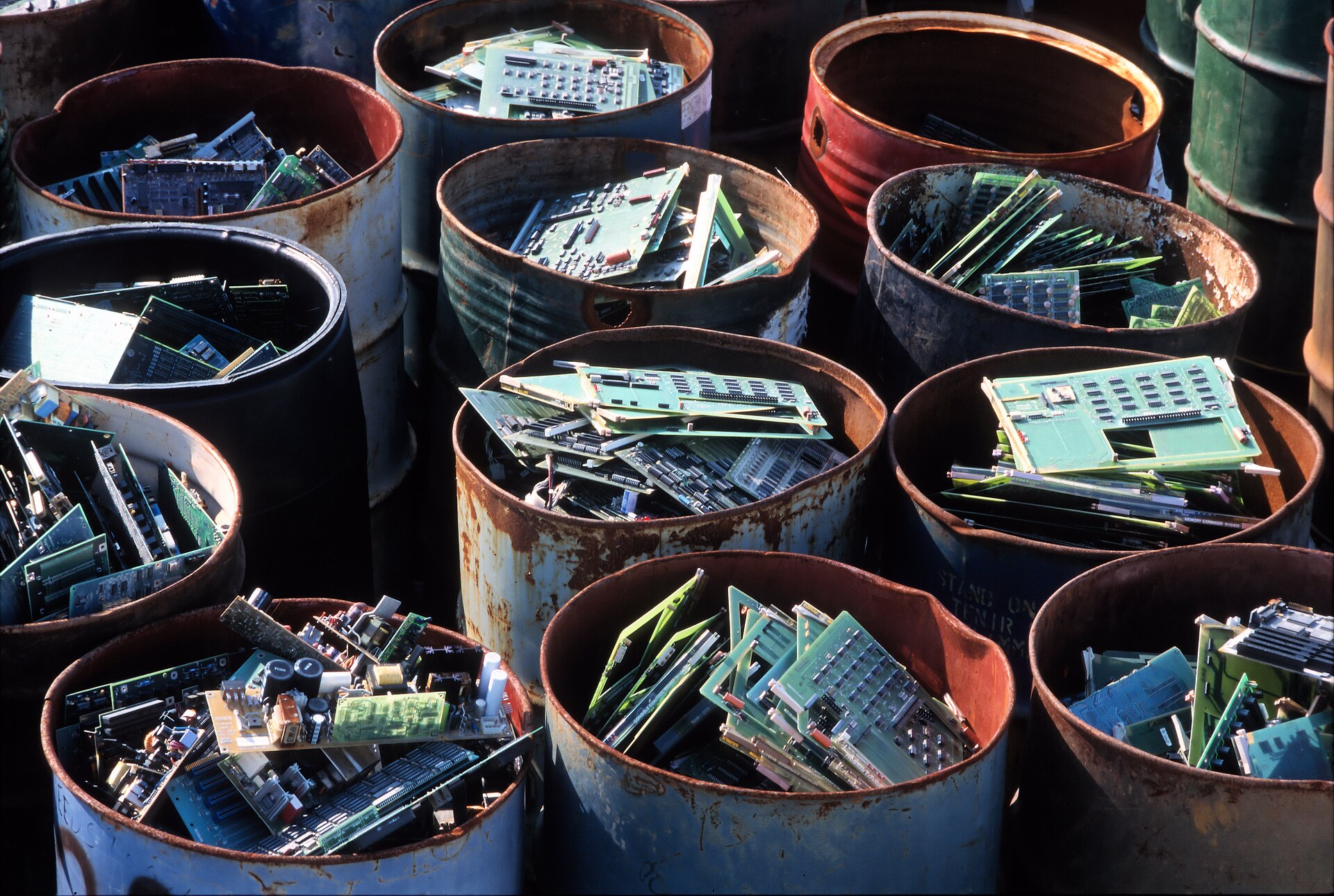
Photo: computer boards and components at a recycling scrapyard in Ottawa, Canada. Paul Harrison, 2012-05-03. CC BY-SA 4.0 · Source. Resized for web.
Start with the condition of the device
A working computer or television is not yet waste. The US Environmental Protection Agency puts reuse and refurbishment ahead of recycling because extending a device’s useful life avoids disposing of it and delays the need for replacement materials. A usable laptop, desktop or flat-screen may be accepted by a school, nonprofit, reuse centre or local donation program, but acceptance standards vary. Call before carrying a large television to a donation site.
A broken device belongs in an electronics collection stream. EPA says community drop-off points, some retailers and manufacturers collect electronics through drop-off, mail-in, take-back and warranty programs. Collected products may be refurbished for resale or dismantled so metals, glass and plastics can return to manufacturing. The agency’s electronics stewardship overview also recommends using certified electronics recyclers.
The distinction is practical:
- Working and complete: look for reuse or donation.
- Broken but intact: use an electronics recycler or approved take-back program.
- Swollen battery, leaking battery or heat damage: do not keep using the device; follow the local battery or household hazardous waste route.
- Television or monitor with a cathode-ray tube: tell the collection site it is a CRT before arrival.
Why the rule changes at a state line
There is no single household disposal rule for every old television and computer in the United States. EPA says 25 states and the District of Columbia have electronics recycling laws. Those laws do not all cover the same devices, users or collection system. A program may be free only for households, may cover televisions but not every peripheral, or may require residents to use a participating municipal site.
That is why a national “all TVs are banned from landfills” answer is unreliable. Some states explicitly prohibit covered devices in the trash. Others create manufacturer take-back programs without the same statewide disposal ban. Local solid-waste districts can add their own rules and fees.
Check three things before choosing a destination:
- Does your state list the device as covered electronic waste?
- Is the program for households only, or does it accept business equipment?
- Does your town require an appointment, proof of residency or a fee for televisions?
A program labelled “free electronics recycling” may still exclude a large CRT, console television, business equipment or a device with a damaged battery.
Illinois: covered electronics cannot go in the trash
The Illinois Environmental Protection Agency says it is illegal in Illinois to throw a defined list of electronic devices into the trash. The state program covers computers, small-scale servers, monitors, televisions, printers, scanners, keyboards, mice and several other consumer devices. Manufacturers participate in the statewide recycling and reuse system.
Illinois EPA also makes an easy-to-miss point: the agency itself does not accept electronics. Residents must use a participating collector, recycler, refurbisher or local program. Start with the Illinois electronics recycling page, then follow its collection links rather than driving to an EPA office.
Connecticut: household drop-off is free for covered devices
Connecticut’s Department of Energy and Environmental Protection says covered electronic devices from households—computers, monitors, printers and televisions—have been banned from the trash since 1 January 2011. Municipalities must provide residents with a free drop-off option for covered devices.
The household qualification matters. Connecticut notes that businesses, schools, government offices and nonprofits must make their own arrangements; the household-funded program does not automatically cover them. Its e-waste guide directs residents to municipal drop-off locations and local recycling coordinators.
This is a good model for reading any state program: “free” often describes eligible household material delivered through the approved channel, not every device from every generator.
California: use the approved collection network
California treats some electronic products as hazardous waste depending on their components and condition. CalRecycle specifically notes that nonfunctioning CRTs and mercury-containing displays can fall into that category. The state’s Covered Electronic Waste Recycling Program supports an approved collector and recycler network, and its eRecycle directory helps residents find a collection point.
California’s system is funded differently from many manufacturer take-back programs: certain devices have carried a recycling fee at sale since 2005. Do not assume that means every place must take every device at the door. Use CalRecycle’s electronic waste page and directory to confirm the collector, device type and conditions first.
CRT televisions and monitors need a confirmed destination
A CRT is the deep, heavy glass tube found in older televisions and computer monitors. EPA says CRT funnel glass generally contains enough lead to be regulated as hazardous waste when disposed. The market for turning old CRT glass into new CRTs has also collapsed, making these devices harder and more expensive to manage than flat screens.
Do not break a CRT to make it fit in a cart or vehicle. Keep the cabinet intact, avoid dropping it and tell the recycler exactly what it is. A site that accepts laptops or flat-screen monitors may refuse CRTs or take them only on specific collection days.
Console televisions can create a second problem: the electronics may be accepted, but the large wood cabinet may not be. Ask whether the whole unit is accepted and whether a television fee applies.
Remove your data before a computer leaves your control
Recycling the hardware does not automatically protect files stored on it. Before donating or recycling a computer:
- back up anything you need;
- sign out of accounts and remove the device from account lists;
- follow the operating system maker’s instructions to erase or reset the drive;
- remove external storage, discs and memory cards;
- keep the serial number and a receipt from the recycler when available.
Deleting visible files is not the same as securely erasing a drive. The right method depends on the drive and operating system. If the device will not start, ask the recycler what data-destruction service it offers and whether it supplies a record. EPA recommends considering data security when choosing an electronics recycler; certified recycler directories can help assess handling practices.
If a laptop or all-in-one computer contains a lithium-ion battery, do not remove it unless the manufacturer provides a safe user procedure. A swollen or damaged pack needs special handling. Our guides to household batteries and lithium-ion batteries explain why batteries do not belong in either curbside bin.
How to find the local answer
Use this order instead of starting with a national junk-removal listing.
- Open your state environmental agency’s electronics or e-waste page.
- Follow its directory of approved household sites or manufacturer programs.
- Check your city, county or solid-waste authority for appointments, residency limits and fees.
- Confirm the exact device—television, CRT monitor, flat screen, desktop, laptop or peripheral.
- Call before bringing a very large set or damaged equipment.
Trashbagging’s drop-off finder can point to local facilities, but the facility’s own current page is the final check. For large televisions, also check the local bulk pickup guide: some cities collect them separately, while others direct residents to an e-waste site.
Never leave a television beside a collection bin after hours. An unattended item may count as illegal dumping even when the site accepts the same material during staffed hours.
What this is not
This is not a promise that every electronics program is free. It is not a list of every state’s covered devices, and it does not replace a collector’s current acceptance rules. It also does not mean that an electronics retailer must accept every brand, size or type of television.
The reliable answer is tied to a place, a device and a generator type. A household desktop in Connecticut, a business monitor in the same town and a CRT television in California can have three different routes.


