
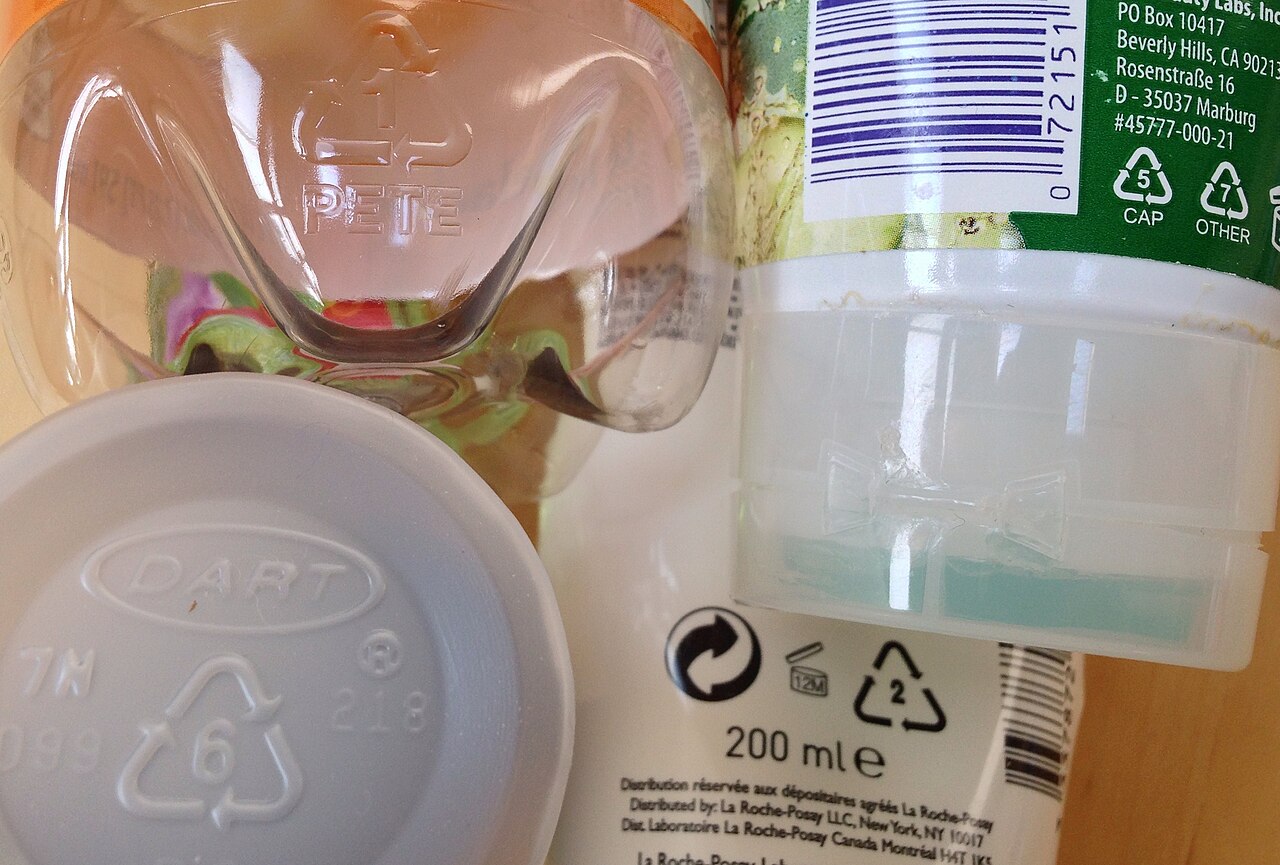
Plastic recycling numbers 1 to 7 name the resin a container is made of; they do not say your cart takes it. The number in the triangle is the Resin Identification Code. Your city’s accepted list decides, and most cities sort by shape: bottles, jugs, tubs and cups go in, while bags, film, foam and utensils stay out whatever number they carry.
Photo: Plastic packaging with molded and printed resin codes 1, 2, 5, 6 and 7. Z22, 2014-07-12. CC BY-SA 3.0 · Source. Resized for web.
The codes run from 1 to 7: 1 PET (or PETE), 2 HDPE, 3 PVC, 4 LDPE, 5 PP, 6 PS and 7 “other”, a catch-all for every other resin and for blends. A number 7 cup and a number 7 lid can be entirely different plastics.
What is true everywhere
The code is now an ASTM International standard, ASTM D7611, which took it over from the plastics industry’s old SPI coding system. It identifies the resin so that recyclers can sort it. It was never a promise that a recycler near you buys it.
The Federal Trade Commission’s Green Guides treat the code that way too. A code molded inconspicuously into the bottom of a container, with nothing more, is not a recyclable claim. The same code printed conspicuously on the front label next to the product name counts as one, and then the seller has to qualify it unless recycling for that item is available to a substantial majority of consumers, which the Guides set at 60 percent.
Shape and size matter as much as resin. The Green Guides say an item made of a recyclable material but not accepted in recycling programs because of its shape, size or another attribute should not be marketed as recyclable. That is why a number 5 yogurt tub and a number 5 fork get different answers in the same city.
Where it turns local
Denver: containers only, and the number alone does not decide
Denver, Colorado, takes plastic containers in the purple cart: bottles, tubs, jugs, jars and cups, empty, with lids attached to bottles. Its recycling FAQ says the city accepts plastic containers labeled 1 through 6, and that anything that is not a container stays out; its example is a plastic fork marked 5, which is refused.
Denver’s accepted list warns that the chasing-arrows symbol alone does not mean an item is accepted, and it lists containers with no resin code among the items to keep out. Plastic bags are the city’s number one contaminant and never go in the cart.
Austin: number 1 to 7 rigid plastic, plus some odd shapes
Austin, Texas, is broader. Austin Resource Recovery’s administrative rules accept plastic containers with the codes PETE, HDPE, LDPE, PVC, PP and PS, which the rules call plastics 1 through 7. The city’s curbside plastics guide of May 5, 2026 lists bottles, jugs, cups, tubs, food containers and jars, attached bottle caps, coat hangers, outdoor furniture and plastic toys without batteries.
Austin still keeps plastic bags and Styrofoam out of the blue cart. Foam is usually number 6, so the number would point the wrong way there.
Seattle: the cart takes containers while the state list is redrawn
Seattle, Washington, asks residents to sort by shape, not number: plastic containers, bottles, jugs and tubs such as milk jugs, soap bottles and yogurt and sauce tubs, empty, clean and dry. Plastic bags and wrap have been out since January 2020.
Behind that list, Seattle Public Utilities adopted a Designated Recyclables List on January 8, 2026. It recommends number 1 PET and number 2 HDPE bottles, jugs and jars for mixed curbside collection, marks number 5 bottles and tubs as only potentially recyclable in mixed collection, and notes that the state Department of Ecology recommends against mixed collection of rigid number 3 to 7 plastics, which Seattle’s residential program accepts today. The utility says it will review the list against the statewide list due by October 1, 2026 under Washington’s 2025 Recycling Reform Act.
California: what the arrows may claim
California’s SB 343 (2021) makes a chasing-arrows symbol, including arrows around a resin code, a deceptive claim unless the item meets the state’s recyclability criteria, which rest on what CalRecycle’s material characterization study finds is collected and sorted statewide. CalRecycle published the study on April 4, 2025, and the label restrictions apply to products and packaging manufactured after October 4, 2026, regardless of when they are sold.
On July 14, 2026, a federal court in California League of Food Producers v. Bonta issued a preliminary injunction that blocks enforcement of SB 343. Packaging on California shelves will keep carrying arrows for some time either way, so the city list remains the answer. See California and San Francisco for local rules.
How to find your local answer
- Open your city or county page and its link to the official recycling list.
- Look for shapes first: bottle, jug, tub, cup, clamshell. If the list names numbers too, check both.
- Empty the container and keep the cap on only where the city says so.
- Keep plastic bags, film, foam, utensils, straws and anything smaller than the city’s minimum out of the cart.
- When the list is silent, the item goes in the trash or to a drop-off the city names, not into the cart on a guess.
What this is not
Not a recycling symbol. The triangle of arrows around the number is a resin code, not a statement that the item is recyclable where you live.
Not a rule for bags and film. A grocery bag marked 2 or 4 is still film. Cities on the site keep bags out of the cart.
Not a rule for foam. Expanded polystyrene carries a 6 but is refused curbside in Denver and Austin; see the Styrofoam guide.


