Getting rid of an inhaler is not the same as recycling an empty drink can. The canister may still contain medicine or propellant after it stops delivering a useful dose, and local programs do not all accept it in the same place. Start with a pharmacy or a city medicine-disposal program, then follow the accepted-items list for that exact site.
Quick answer: Keep the inhaler intact and check a pharmacy or local medication take-back program. Do not put it in curbside recycling unless your local authority explicitly says it accepts inhalers.
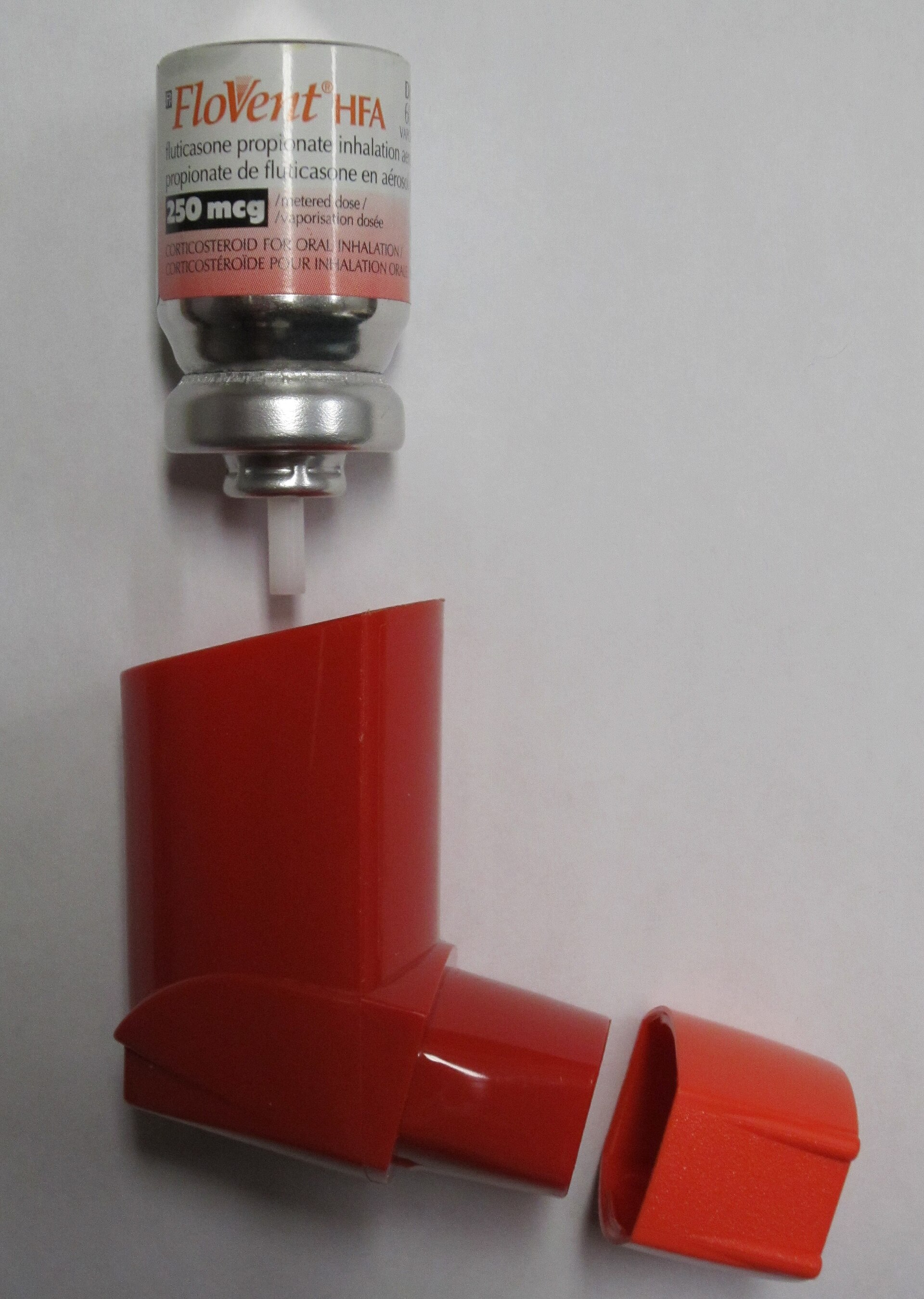
Photo: Fluticasone metered-dose inhaler. James Heilman, MD, 2010. CC BY-SA 3.0 · Source. Resized for web. Product appearance is shown for disposal context.
What to do with an unwanted inhaler
- Read the medicine label and pharmacy instructions. A device that is expired, empty, damaged or no longer prescribed still needs the disposal route used where you live.
- Call a pharmacy or search your local waste authority’s medicine page. Ask whether it accepts inhalers specifically. “Medicine take-back” does not automatically mean every site takes pressurized devices.
- Keep the canister and device intact. Do not puncture, crush or dismantle an inhaler to make it fit another waste stream.
- Transport it as a whole item. Keep the cap on if you have it and place the inhaler in a small bag so it does not roll around in your car or leak into other items.
- Use the exact accepted route. In Austin, for example, the city’s permanent pharmaceutical kiosk lists inhalers and nebulizers among accepted items. Its same list refuses ordinary aerosol spray cans, so residents should not treat those two categories as interchangeable.
The practical rule is simple: look for the word inhaler on the accepted-items list, or confirm it with the pharmacy before making the trip.
Why inhalers stay out of ordinary recycling
Pressurized metered-dose inhalers can retain propellant even when the dose counter is at zero. Cornwall Council says inhalers are not collected in household recycling and directs residents to pharmacies, where they are treated with medicine waste. Hillingdon Council gives the same route and explains that thermal treatment destroys the remaining greenhouse gases.
That does not mean every inhaler contains the same material. Dry-powder inhalers, soft-mist devices and metered-dose inhalers are built differently. A recycler cannot safely sort that difference from a household bin, and a metal canister does not become curbside-recyclable just because its shell looks like packaging.
Do not guess from the recycling symbol on an outer box. A clean paper carton and instruction leaflet may follow your local paper rules, but the inhaler itself follows the medicine or device rule.
A United States example: Austin
Austin Resource Recovery operates a free, anonymous pharmaceutical kiosk for items from individuals at Travis County Constable Precinct 5, 1003 Guadalupe Street. Its published list accepts:
- inhalers and nebulizers
- blister packs
- creams, ointments and lotions
- liquid medicine in containers of no more than four ounces
- pills, tablets, capsules and powders
The kiosk does not accept needles or syringes, household chemicals, batteries or ordinary aerosol spray cans. That is a useful reminder that the destination depends on the product, not just on whether it has a spray mechanism.
Austin also points residents to the DEA public disposal locator and pharmacy programs, while warning that other sites may have different rules. Check the individual collection point before visiting; do not assume that a kiosk found through a national locator accepts inhalers.
A United Kingdom example: pharmacy return
In England, several councils give a consistent pharmacy route. Cornwall Council says used inhalers should be returned to a pharmacy and not placed in household recycling. Hillingdon Council says all used inhalers should go to the nearest pharmacy for safe disposal.
That rule is useful for residents in those council areas, but it is not a universal rule for the United States. In the U.S., acceptance can vary by pharmacy, law-enforcement kiosk, hospital program and household hazardous waste facility. Confirm before you travel.
Empty, expired and partly full inhalers
- Expired or no longer needed: use the pharmacy or medicine take-back route; do not save it for “just in case” use without medical advice.
- Dose counter at zero: treat the device as an inhaler, not as scrap metal. It may still contain propellant.
- Partly full: keep it intact and use a confirmed take-back site.
- Damaged or leaking: keep people away from it and call the pharmacy or local household hazardous waste program for handling instructions. Do not test, puncture or empty it yourself.
- Outer packaging: recycle only clean paper or cardboard that your local program accepts. Remove prescription labels or other personal information first.
What not to do
- Do not put an inhaler in curbside recycling based only on its metal canister.
- Do not puncture or crush it.
- Do not burn it or place it near heat.
- Do not flush medicine or spray the remaining doses into the air to “empty” the device.
- Do not put needles, syringes or lancets in the same bag; those need an approved sharps disposal route.
- Do not assume a general drug kiosk accepts pressurized devices.
Before you leave home
A two-minute check can prevent a wasted trip:
- search your city or county website for “inhaler disposal”
- call the pharmacy and ask specifically about inhalers
- confirm the site’s address, hours and resident eligibility
- ask whether an appointment or proof of residency is required
- keep the device capped and intact
If the nearest pharmacy says no, ask which local program it refers customers to. Your city or county solid-waste office can also tell you whether inhalers belong with medicines, household hazardous waste or another special collection.