How to dispose of glass depends on where you live: many curbside programs still take bottles and jars, but some have dropped glass because it breaks, contaminates other recyclables and is heavy to haul. Ten states pay you a deposit instead, a nickel or a dime a bottle.
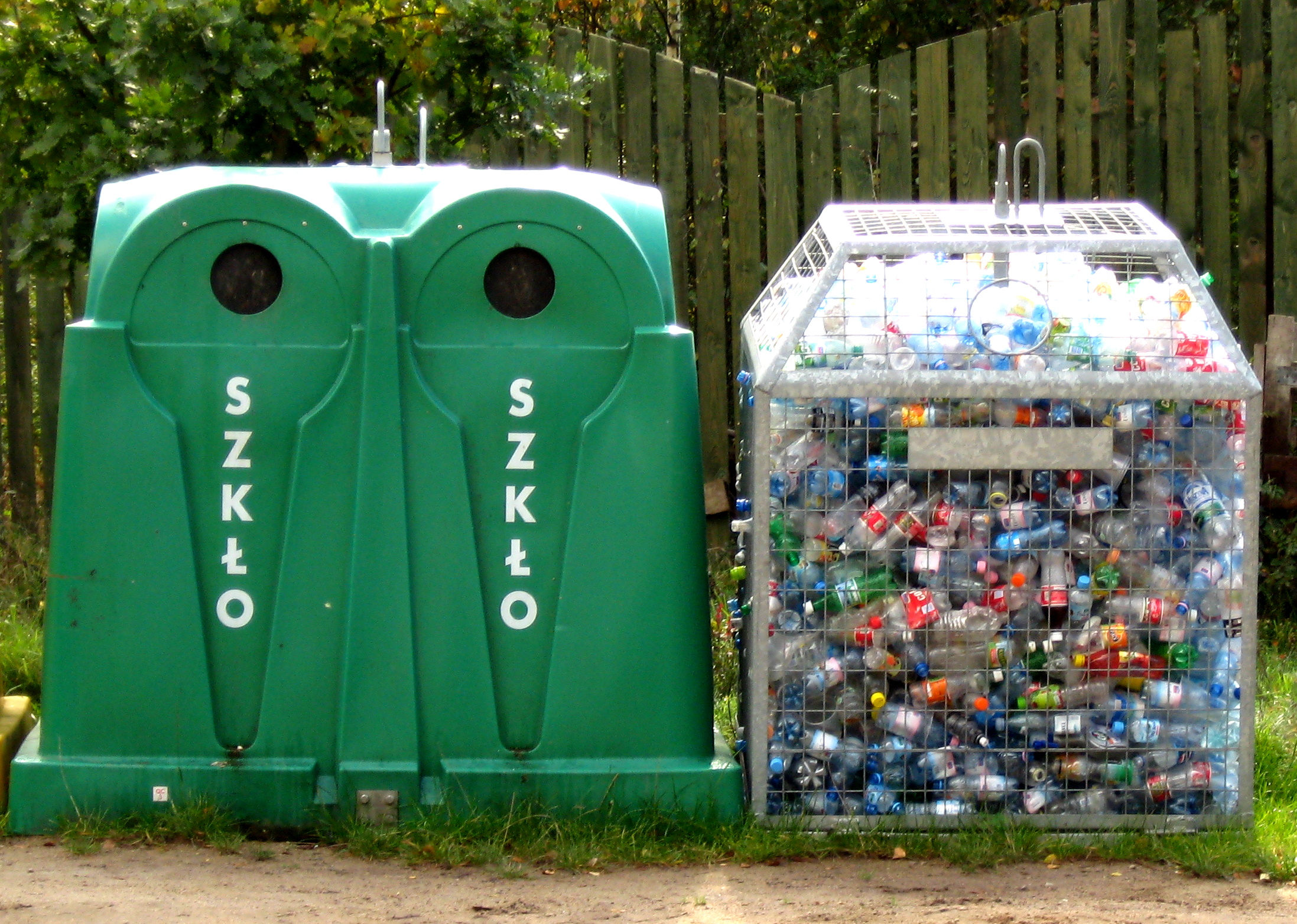
Context photo: glass and plastic bottles sorted for recycling. Tomasz Sienicki, 2008-09-25. CC BY 3.0 · Source. Resized for web.
What’s true everywhere
- Glass can be recycled over and over. The Glass Packaging Institute says it “can be recycled endlessly with no loss in quality or purity.” In practice the United States recycled 31.3% of glass containers in 2018, the most recent figure in the EPA’s published data (3.1 million tons).
- When a county drops glass from curbside collection, the reasons are practical. Fairfax County, Virginia, said broken glass contaminates bales of more valuable recyclables, the abrasive pieces damage machinery, and glass is heavy, which adds cost to hauling.
- Whether your own program takes glass is a local rule. Check your city’s or county’s recycling list before you put bottles in the cart.
- Window panes, mirrors, drinkware, ceramics and light bulbs are not bottles or jars. See How to dispose of light bulbs.
Where it turns local: the ten deposit states
Ten states run container-deposit (“bottle bill”) programs that refund a few cents when a covered beverage container comes back, glass bottles included. The Glass Packaging Institute lists the ten: California, Connecticut, Hawaii, Iowa, Maine, Massachusetts, Michigan, New York, Oregon and Vermont. Deposit and refund rules differ by state.
- California: 5 cents on containers under 24 ounces and 10 cents at 24 ounces or more. Since January 1, 2024, boxes, bladders and pouches of wine and distilled spirits carry 25 cents (CalRecycle).
- Michigan: a 10-cent deposit, refunded when the container is returned (State of Michigan).
- Oregon: a 10-cent refund since January 1, 2018. A 2011 law (House Bill 3145) raised it from 5 cents once the redemption rate fell below 80 percent for two years running (Oregon DEQ). The Container Recycling Institute put Oregon’s 2025 redemption rate at 88%.
- Connecticut: 10 cents, up from 5 cents on January 1, 2024 (Connecticut DEEP). The Container Recycling Institute put the 2025 rate at 92%, the highest of the ten.
- Massachusetts: a 5-cent deposit on carbonated soft drink, beer, malt beverage and sparkling water containers (Mass.gov). Its 2025 redemption rate, 33%, was the lowest of the ten states.
- New York: a 5-cent deposit. Wine is not covered by the bottle bill, according to the Wine Institute’s compliance guide, so wine bottles do not earn a refund.
- Maine: a refund of at least 5 cents on most containers. For wine and spirits containers over 50 milliliters the refund may not be less than 15 cents (Maine statutes, 38 M.R.S. section 3103).
- Vermont: 5 cents, with liquor bottles at 15 cents according to the Glass Packaging Institute. Vermont’s Act 158 of 2026 (House Bill 915), approved June 17, 2026, sets up a producer-responsibility program for beverage containers; check the state’s program page for current figures.
- Iowa: a 5-cent deposit (Iowa DNR). The 2025 redemption rate was 49%, per the Container Recycling Institute.
- Hawaii: a 5-cent deposit under the HI-5 program (Hawaii Department of Health). Hawaii’s redemption rate was 52% in 2025, the third-lowest of the ten, and the program fund held $105 million in September 2026 (Honolulu Star-Advertiser, citing the Container Recycling Institute).
How to find your local answer
- Check your own city’s or county’s recycling list first (its page on this site, or its official collection page). Some programs still take clean glass bottles and jars.
- If your program excludes glass, look for a glass drop-off site run by your city or county.
- Live in one of the ten states above? A store or redemption center refunds the deposit; the recycling cart does not.
What this is not
- Window glass, mirrors, drinkware, ceramics and light bulbs are not bottles or jars (see How to dispose of light bulbs).
- A broken bottle on the kitchen floor is a safety problem, not a recycling question. See How to Dispose of Broken Glass Safely for how to bag and dispose of shards.
- A deposit refund is not the same as curbside eligibility. Whether the cart takes glass is up to your city or county.