How to dispose of brake fluid: put the old fluid in a sealed, labeled container, keep it apart from motor oil and antifreeze, and take it to a household hazardous waste site or collection event. It never goes down a drain, into a storm drain, onto the ground or into a trash or recycling cart. Which site takes it, how much and on what days is set by your city or county.
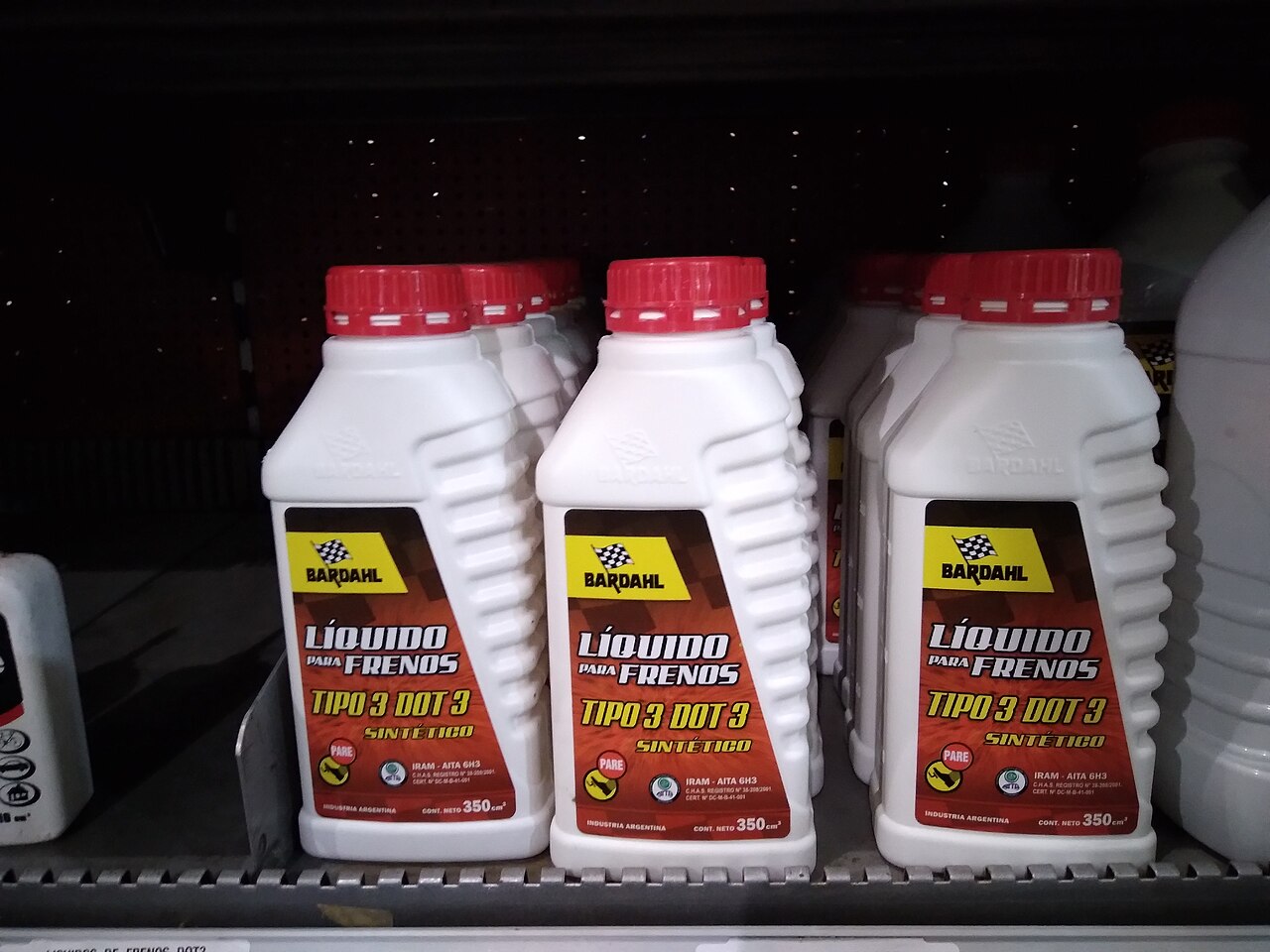
Photo: Bottles of DOT 3 brake fluid on a store shelf. Just a Man, 2023-10-13. CC BY 4.0 · Source. Resized for web.
What is true everywhere
- There are four kinds, and the bottle tells you which. The federal brake fluid standard (FMVSS 116) requires every container to say DOT 3, DOT 4, DOT 5.1 non-silicone base or DOT 5 silicone base. DOT 5 is at least 70% silicone by weight; the others are not. For disposal the kind does not change the route: the collection sites below list “brake fluid” without splitting it by type.
- The label already warns you. The same standard makes every bottle carry the lines “store brake fluid only in its original container”, “keep container clean and tightly closed to prevent absorption of moisture” and “do not refill container, and do not use for other liquids.” It also warns that contamination with dirt, water or petroleum products may cause brake failure, so used fluid is drained out of the system, never poured back in.
- The drain and the ground are out. New York’s Department of Environmental Conservation lists brake fluid among the harmful automotive products in a home and says never to mix automotive products or pour them into storm drains, septic systems or onto the ground.
- Do not pour it into the oil jug. King County’s hazardous waste program tells households not to mix brake fluid, power steering fluid, transmission fluid or gear oil with used motor oil. Business rules can differ: Minnesota’s Pollution Control Agency lists brake fluid as used oil in its guidance for shops and other generators. A household cannot know which rule the place it brings the oil to follows, so the safe choice is a separate container.
Where it turns local
Three cities with pages on this site show how much the answer changes:
| Seattle and King County | Houston | Philadelphia | |
|---|---|---|---|
| Where | Four county hazardous waste sites | Two Environmental Service Centers | Household hazardous waste events |
| Cost | No fee, no appointment | No fee stated; proof of address required | Not stated; no registration |
| How much | 50 gallons a trip, containers of 5 gallons or less | Automotive products “15 quarts max = 3 gallons” | No limit given |
| Who may come | King County residents | Texas ID, or a Houston utility bill or lease | Bucks, Chester, Delaware, Montgomery and Philadelphia county residents |
| When | Every week; site days differ | South: four days a week; North: one day a month | 2026 events are over; 2027 dates not yet posted |
Seattle and King County: free at four sites
- In Seattle and the rest of King County, Washington, brake fluid is on the county’s list of automotive fluids taken at its hazardous waste sites, with no fee and no appointment.
- The North Seattle Hazardous Waste Facility, 12550 Stone Ave N, is open Sunday to Tuesday, 9 a.m. to 5 p.m. The South Seattle Hazardous Waste Facility, 8100 2nd Ave S, next to the transfer station, is open Thursday to Saturday, 9 a.m. to 5 p.m. The Factoria site in Bellevue and the Algona site at South County Recycling and Transfer Station are each open six days a week.
- All four close on Thanksgiving Day, Christmas Day and New Year’s Day, so the South Seattle site is shut on Thursday, November 26, 2026.
- Residents 65 or older, or with a disability, who cannot get to a site can call the Haz Waste Help Line at 206-296-4692 for a Wednesday home pickup.
Houston: Environmental Service Centers, with proof of address
- In Houston, Texas, “transmission and brake fluid” is on the accepted list at the City’s Environmental Service Center South, 11500 S. Post Oak Rd., open Tuesday, Wednesday, Friday and Saturday, 8 a.m. to 5 p.m., and Environmental Service Center North, 5614 Neches St., open only on the second Thursday of each month, 9 a.m. to 3 p.m.
- Bring a current Texas-issued ID, or a current City of Houston utility bill or lease.
- The automotive limit reads “15 quarts max = 3 gallons.” Fifteen quarts is 3.75 gallons, so the two figures on the City’s page do not match. Plan on the smaller one: twelve 1-quart bottles of old fluid fit under both, fifteen fit under the quart figure only. Call 311 before you bring more than 3 gallons.
Philadelphia: events only, and the 2026 season is over
- In Philadelphia, Pennsylvania, brake fluid is on the accepted list at the City’s household hazardous waste collection events, which run 9 a.m. to 3 p.m. with no registration. Businesses must use a private service.
- The last 2026 event was Saturday, November 7, in Port Richmond. The City’s page lists no 2027 dates yet, so keep the fluid sealed until the City posts its 2027 events.
- The City’s packing rules: never mix products, keep them in their original containers with the labels on, seal every lid, put a container that will not close in a sealed plastic bag, and wedge everything in a sturdy box for the drive.
How to find your local answer
- Keep old fluid in a clean container that closes tightly, label it “used brake fluid,” and keep it away from children and pets.
- Open your city page from States & Cities and look under hazardous waste and drop-off sites for a facility or event that lists brake fluid or automotive fluids.
- Search the drop-off locations catalog for a household hazardous waste site near you and check its limits and proof-of-residence rule before you drive.
- If your county runs only seasonal events, keep the container sealed and upright in a garage or shed until the next one.
What this is not
- Not motor oil. Used motor oil has its own guide: used motor oil and filters. Brake fluid goes in its own container.
- Not antifreeze. Coolant also goes to hazardous waste sites, in a separate jug; see antifreeze.
- Not brake cleaner. Brake parts cleaner is a solvent sold in aerosol cans, not a fluid you drain; see aerosol cans.