How to dispose of pesticides depends on the product and your local collection program. Keep leftovers in their labeled containers, follow the disposal instructions and confirm a household hazardous waste destination before loading the car.
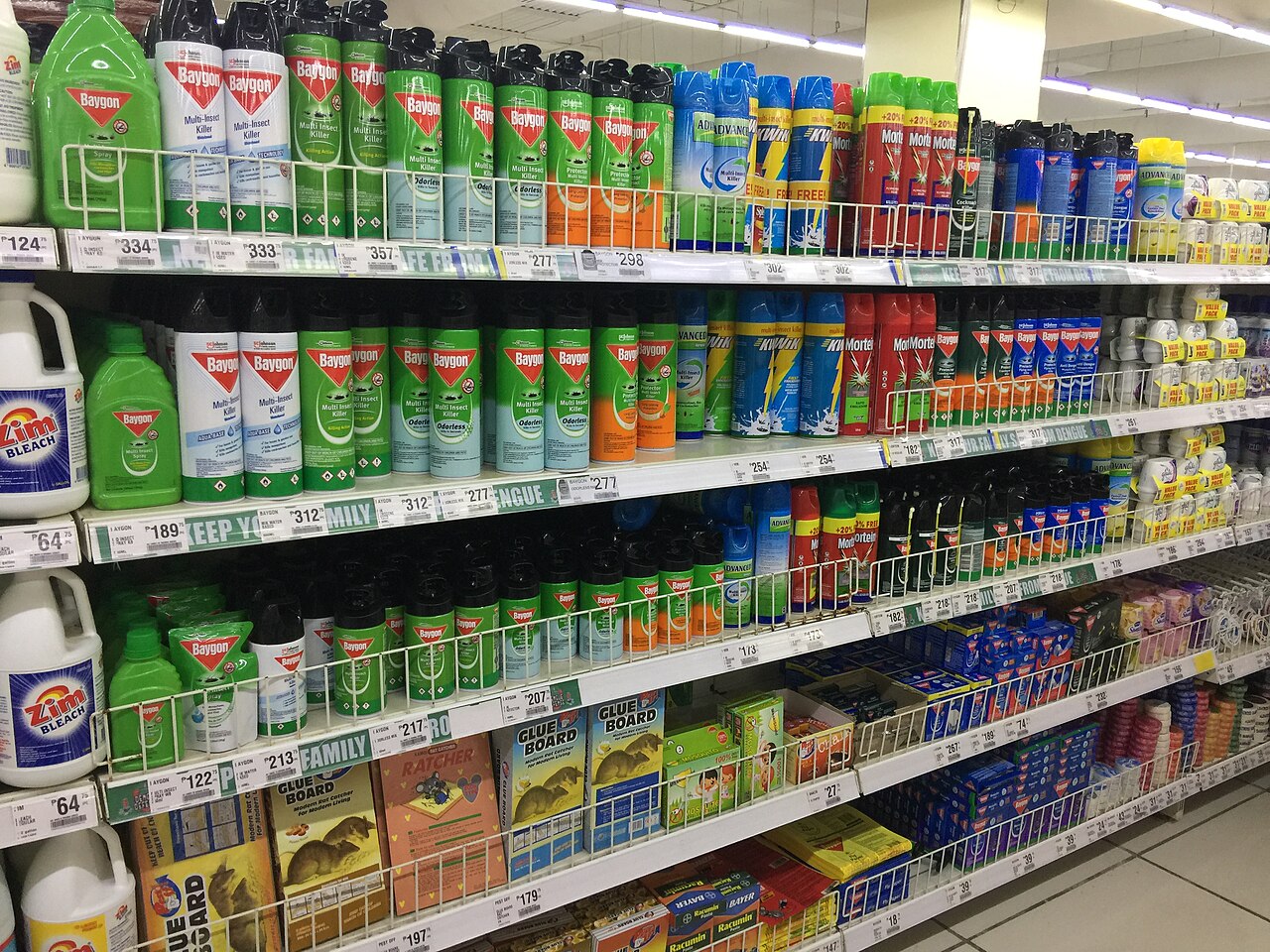
Context photo: Insecticide products on supermarket shelves in Davao, Philippines; packaging illustration, not a US disposal facility. 2011Windows7SP1, 2022-04-12. CC BY-SA 4.0 · Source. Resized for web.
A bottle that still holds weed killer needs a different decision from an empty container. Read the “Storage and Disposal” section on the exact product, then ask your city or county program what it accepts. A recycling symbol on the bottle does not establish that a local recycling cart accepts it.
Separate leftovers from empty packaging
The National Pesticide Information Center, a cooperative program of Oregon State University and EPA, says remaining product should go through household hazardous waste disposal. The label and state or local rules govern the route.
Keep the container and label together. Tell the collection program the product name, whether the container is full or partly full, and the approximate quantity. If the label is missing or the contents are uncertain, describe that uncertainty when asking for instructions.
Empty packaging is a separate question. NPIC warns against reusing pesticide containers. Follow the product’s container instructions and the local collection rules; do not improvise a rinsing method or put rinse water into a drain.
For the wider collection process, see household hazardous waste.
Where it turns local
King County, Washington
King County’s household pesticide guidance accepts household pesticides and poisons at hazardous waste collection sites, including insect killers, fungicides and herbicides. It excludes professional-grade pesticides and herbicides.
Its published limits are containers of five gallons or less and fifty gallons of total waste per trip. The county tells residents to put empty pesticide and fertilizer containers in the garbage, not recycling. Those are King County instructions, not a nationwide rule.
The county’s facility directory says its household collection sites and traveling Wastemobile serve King County residents without an appointment or a fee. Check the chosen location’s operating day before traveling. Our North Seattle facility record links to the county’s official facility information. Our King County page and Washington guide provide the broader local collection context.
Columbus, Ohio
SWACO’s household hazardous waste program serves Franklin County residents and lists insecticides, rat poison, lawn chemicals and fertilizers among accepted materials.
Its facility is at 645 E. 8th Avenue in Columbus. Published hours are Monday–Friday, 9 a.m.–5 p.m., and the first Saturday of the month, 9 a.m.–2 p.m., closed holidays. The residential program is not offered to businesses; businesses must contact the operator about a separate service and cost.
Our SWACO facility record links to the official program. Do not confuse that facility with the regular garbage cart or assume every recycling drop-off accepts pesticides. See the Columbus trash pickup schedule and Ohio guide for the city’s other waste streams.
Store safely while waiting
NPIC’s storage guidance recommends the original container with its original labeling. Keep it in a well-ventilated place inaccessible to children and pets, away from food, animal feed, flames and water sources. Follow the label’s temperature and storage instructions.
Do not transfer leftovers into a drink bottle. A larger outer container can help contain a leak, but the pesticide should remain in its own labeled packaging. Ask the collection program for handling instructions if a container is damaged.
Prepare the collection trip
NPIC advises securing containers against movement and spills, keeping them out of the passenger compartment and away from groceries, and going directly to the collection site.
Before leaving, confirm four details with the receiving program:
- The exact product and amount it accepts.
- Household residency or other eligibility.
- Container and transport instructions.
- Today’s opening hours, appointment requirement and fees.
A household program’s acceptance list does not automatically apply to farm, landscaping or pest-control business waste.
How to find your local answer
Search your city or county’s official hazardous-waste pages for the product type, then confirm the receiving program’s conditions. Describe the pesticide rather than asking whether it takes “chemicals.” A household weed-killer bottle, a professional product and empty packaging may follow different routes.
What this is not
This guide covers household pesticide and weed-killer disposal. It does not establish a route for commercial or agricultural waste, and it does not replace the instructions on the product label.