How to dispose of carpet comes down to one tape measure and one phone call. Most city crews take old carpet with the trash or bulk pickup only after you cut it into short strips, roll it and tie it, and the size each city accepts differs. Carpet a contractor pulled up is the contractor’s to haul. In California, and in New York from July 2027, a state program also gives you a recycling drop-off.
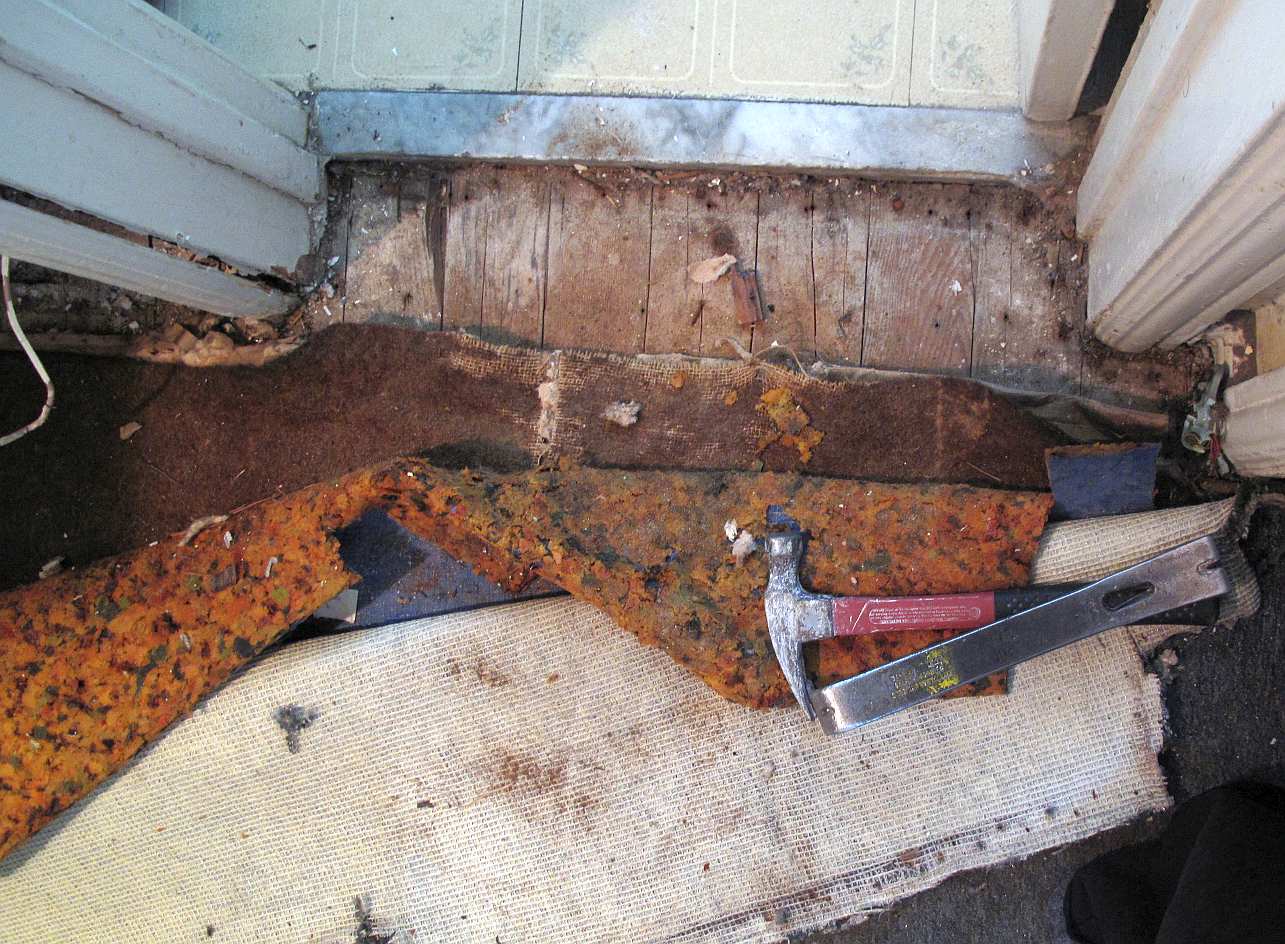
Photo: Old wall-to-wall carpet and its foam pad lifted from a wood floor in a Los Angeles apartment, with a hammer and pry bar. Downtowngal, 2018-12-18. CC BY-SA 4.0 · Source. Resized for web.
The size limit decides everything
Cities that collect carpet at the curb set their own rules for how it is cut and tied, and the numbers are not the same. Three cities with pages on this site show how far apart the rules are:
| New York City | Minneapolis | Houston | |
|---|---|---|---|
| Size of each roll or bundle | Up to 4 feet long and 2 feet high; cut rugs to 4-foot widths | Under 5 feet long, under 12 inches across, under 40 pounds | No size given; carpet must be secured or bundled |
| How to tie it | Roll and tie securely with twine | Rope, twine or tape; never wire | Secured or bundled |
| Which pickup | Trash, not recycling | Garbage day, with a “For Solid Waste” note on each item | Heavy trash on your junk waste day, even-numbered months only |
| How much at once | Up to 6 bags or bundles of your own home-repair debris | Up to 2 large items a week | Up to 8 cubic yards per pile |
| When it goes out | Between 6 p.m. and midnight the night before | By 6 a.m. on pickup day | From 6 p.m. the Friday before until 7 a.m. on your day |
Your city’s own rule will differ. Look it up on your city page or in bulk pickup rules by city before you start cutting, because the width you cut the strips to is the number that matters.
One room, worked through
Take a 12-by-15-foot bedroom: 180 square feet, or 20 square yards of carpet.
- In New York City, cut it lengthwise into three strips 4 feet wide and 15 feet long, then roll each strip from one end. Each roll is 4 feet long, inside the limit, and three bundles fit under the six-bundle cap for one collection day. If a roll ends up more than 2 feet high, cut that strip in half and roll the pieces separately.
- In Minneapolis, the same 4-foot strips give rolls under the 5-foot limit, but each roll must also stay under 12 inches across and 40 pounds. A thick carpet may need shorter strips to stay under both. The City’s page allows two large items a week and does not say whether each roll counts as one, so call Solid Waste & Recycling at 612-673-2917 before you set out more than two.
- In California, the same 20 square yards bought new carries the state carpet assessment on the receipt: $21.00 at the broadloom rate of $1.05 a square yard, or $19.20 at $0.96 if the carpet has at least 10% certified post-consumer recycled content. That money pays for the drop-off network described below.
Pulled up by a contractor? Then it is not curbside carpet
City pickup is for the resident’s own small jobs. New York City accepts up to six bags or bundles of home-repair debris only when you did the work yourself; if you hired anyone, the debris goes out through a private carter. Houston does not collect contractor-generated debris from remodeling. When a flooring store or installer tears out the old carpet, put its removal and disposal in the written quote.
Recycling carpet: California now, New York from 2027
California has run a carpet stewardship program since state law created it. CalRecycle oversees it and Carpet America Recovery Effort (CARE), a nonprofit set up by carpet manufacturers, runs it. CARE supported 174 public drop-off sites at the end of 2025, with at least one in each of the state’s 58 counties. Drop-off may cost something, but CARE says the fee is usually less than the landfill fee, and it asks sites to discount carpet prepared for recycling. CARE’s preparation rules:
- keep the carpet dry and free of debris, with tack strips, nails and trash removed;
- cut it into manageable sections, separate the carpet from the pad, and roll each;
- carpet damaged by water, fire or smoke cannot be recycled.
The per-yard assessment may change. CalRecycle conditionally approved CARE’s revised assessment plan on September 14, 2026 and gave CARE until November 13, 2026 to resubmit it; CARE expects the new structure to take effect no earlier than April 1, 2027. Area rugs are not assessed. Carpet tile carries a higher rate than broadloom: $1.49 a square yard, or $1.40 with 10% or more post-consumer content. Find a site on CARE’s California drop-off map and call ahead about hours and fees.
New York’s carpet law took effect December 28, 2024 and requires carpet producers to fund a collection program at no cost to consumers. Under the Department of Environmental Conservation’s enforcement letter, producers have until December 31, 2026 to submit their collection plans, and the program is to begin by July 1, 2027. Until then, New York City carpet goes out with the trash under the rules above. Separately, from December 31, 2026 no carpet sold in New York may contain or be treated with PFAS.
Area rugs and wall-to-wall carpet
The curbside rules above apply to both. New York City’s rule names “rugs and carpets” together, and Minneapolis lists “carpet and rugs” under the same roll limits.
How to find your local answer
- Open your city page and its bulk or large-item section for the size limit and the pickup day.
- Compare with bulk pickup rules by city if your city has no page yet.
- In California, check the California hub and CARE’s map; in New York, the New York hub.
- For a landfill or transfer station that takes carpet by the load, search the drop-off catalog.
What this is not
This guide covers the carpet itself. Leftover carpet shampoo and cleaning solutions are a separate question: see household hazardous waste. Mattresses have their own state programs: see mattress disposal.