How to dispose of pool chemicals: keep leftovers separate and arrange household hazardous waste collection. Austin and King County explicitly accept them through their hazardous-waste programs. The appointment, container limit and household eligibility come from the local program, not the recycling symbol on the bottle.
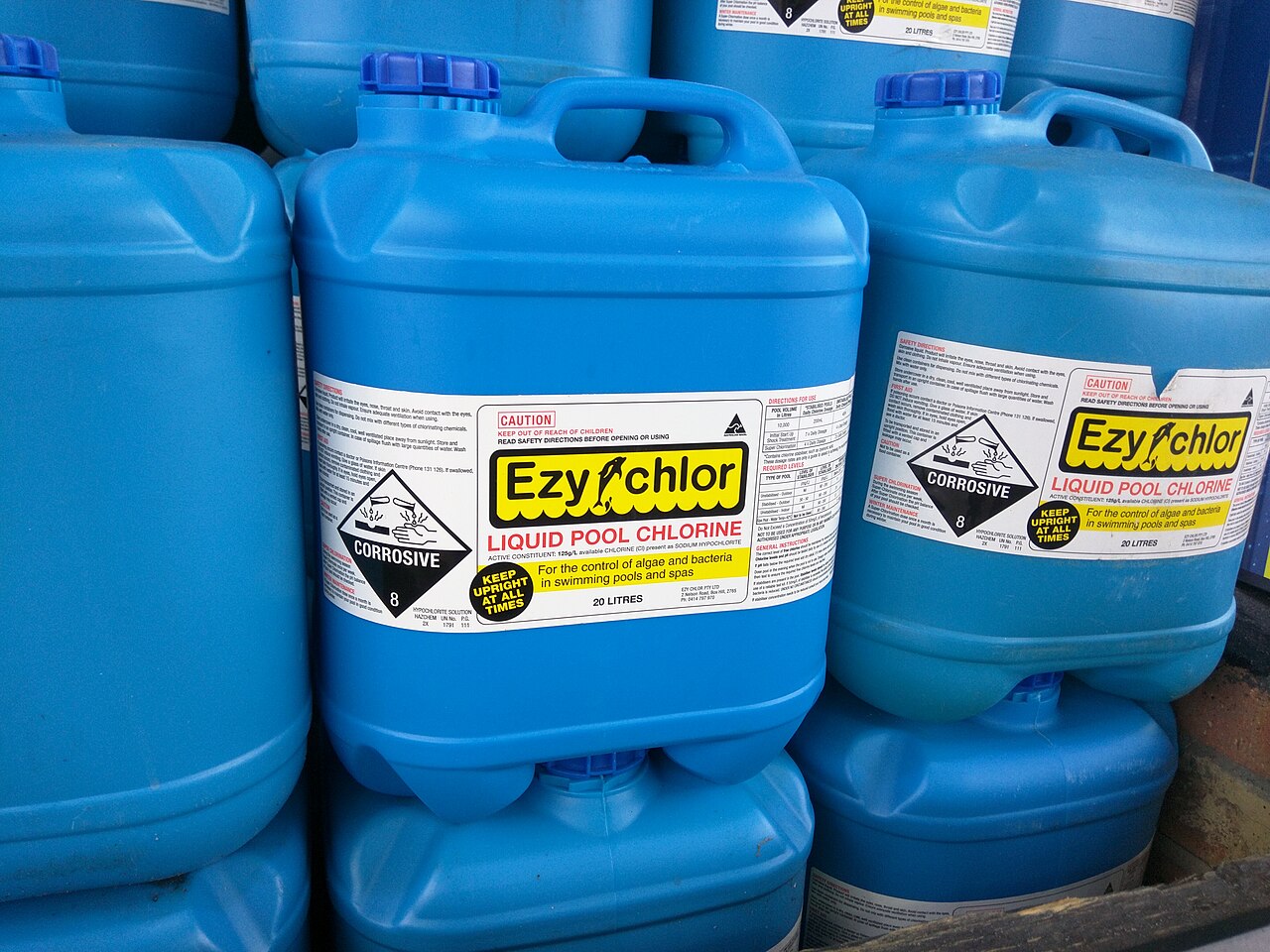
Photo: Liquid pool chlorine containers in Australia. Maksym Kozlenko, November 14, 2015. CC BY-SA 4.0 · Source. Resized for web.
Start with the product and its condition
Read the label before deciding how to handle an unwanted pool product. Keep chlorine products, acids and other chemicals in their original labeled containers. Do not combine leftovers to save space.
The CDC’s pool chemical safety guidance says to keep chemicals dry, protect them from heat, and store incompatible products separately. For a damaged container, consult the manufacturer. For deteriorating, unwanted or unlabeled chemicals, contact the manufacturer or local hazardous-materials program for disposal instructions.
A partly full bottle and a genuinely empty container are different questions. Tell the collection program which you have. Do not treat a container holding residue as ready for curbside recycling just because its plastic has a number.
Why pool chemicals stay out of ordinary trash
San Joaquin County’s pool-chemical guidance explains that common products can be reactive or corrosive. Improper mixing, moisture and contact with incompatible materials can cause fires or toxic vapors. The county directs residents away from garbage and toward its household hazardous waste facility.
That risk also rules out improvised disposal experiments. Do not mix products, add water to an old chemical to get rid of it, or pour leftovers into a household drain. Austin’s hazardous-waste guidance specifically warns against putting household hazardous waste in trash or down drains.
A chemical collection is not an invitation to handle a leaking or damaged package without advice. Describe its condition when booking and ask the program how it wants the material handled.
Where the answer turns local
Austin, Texas: appointment or eligible curbside collection
Austin’s Recycle and Reuse Center lists pool chemicals among accepted household hazardous waste. An appointment is required. The facility is free for Austin and Travis County residents except for tires; people outside that area face fees. Business hazardous waste is not accepted.
For drop-off, the city specifies containers of 5 gallons or less, original packaging, and small containers upright in sturdy boxes. It says not to mix products or bring them in a trash bag. Ask for instructions before bringing a damaged container.
Austin Resource Recovery curbside customers can also book household hazardous waste collection. The city’s on-demand collection article explicitly includes pool chemicals and links booking through the Austin Recycles app, online or 3-1-1. Eligibility for that pickup is narrower than residence anywhere in the county.
See Austin’s collection guide and the Texas hub for the rest of the local service.
King County and Seattle, Washington: household collection sites
King County’s household pool-chemical instructions accept swimming pool chemicals at hazardous waste collection sites. Containers must be 5 gallons or less, with a total waste limit of 50 gallons per trip. Those are King County household limits, not a national allowance.
Use the linked household disposal service to choose a location and confirm its arrangements before travelling. For a question about an unusual product or quantity, the county lists 206-296-4692, Monday through Saturday, 9 a.m. to 5 p.m., except holidays.
Keep the household instructions separate from King County’s business program: businesses have their own eligibility and disposal requirements.
The Seattle guide, King County guide and Washington hub connect the hazardous-waste route with local collection information.
Find the right route before loading the car
Look up “pool chemicals” on your city or county’s official waste site. Confirm:
- Whether the service takes the particular product and its current condition.
- Whether your address qualifies for household drop-off or booked pickup.
- The appointment and container requirements.
- Whether the material came from a home or a business.
Use the drop-off finder to locate a possible facility, then read that operator’s accepted-material list. A recycling center that takes bottles is not automatically a chemical collection site.
What this is not
Unwanted concentrated pool chemicals are not the same as swimming-pool water. Instructions for draining a pool do not establish a disposal route for leftover chlorine or acid.
This is also separate from empty aerosol cans and propane tanks, household cleaners and pesticides. Keep products identifiable instead of combining them into a general cleanup mixture.